Visuals for autism are pictures, symbols, cards and printed sheets that show a child what is happening, what comes next and how to say what they need. Many autistic children process what they see more easily than what they hear, and a picture stays put long after spoken words have faded. That makes a simple printed card one of the most practical, low-cost supports you can use at home, at school and out in the community.
This library brings together 40 free autism printables and visual supports from Autism 360, grouped by what they help with: communication, routines and daily living, behavior and regulation, social understanding, and data tracking for parents and clinicians. For each type you will find what it is, when to reach for it and how to introduce it, with a link to the full guide and download.
What are visuals for autism and why do they help?
Visual supports are any concrete, visible prompt that carries information: a photo of the park, a picture symbol for “help”, a strip that shows “first shoes, then car”, or a chart that tracks tokens toward a reward. They range from real objects (handing your child a towel to signal bath time) to photos, line drawings, picture symbols and, later, written words.
Visuals for autism help for a few clear reasons:
- They last. Spoken words disappear the moment they are said. A visual can be looked at again and again, at your child’s own pace.
- They reduce uncertainty. Knowing what is happening now and next lowers the stress that often sits behind meltdowns, shutdowns and resistance to transitions.
- They give a way to communicate. A child who cannot find words in the moment, or who does not use speech, can point to or hand over a card.
- They build independence. A sequence of pictures lets a child follow a routine without an adult repeating each step.
Visual supports are recognized as an evidence-based practice for autistic children and young people by the National Clearinghouse on Autism Evidence and Practice (Steinbrenner and colleagues, 2020), and they are a standard recommendation from speech-language pathologists, occupational therapists and teachers. They are also neuroaffirming: rather than asking a child to process information the way everyone else does, they meet the child where their strengths are. Our guide to autism learning styles explains why visual learning is a common strength.
If you are still working out whether your child is autistic, our free online autism screening test is a good first step. Visuals are helpful for many children with or without a diagnosis, so there is no need to wait to start using them.

How to choose the right visual for your child
With so many types of printable visuals for autism available, it helps to start from the problem you want to solve rather than the resource itself. Use this quick guide:
- “My child can’t tell me what they want or what’s wrong.” Start with communication cards, a choice board or a help card.
- “Transitions and routines are a battle.” Start with a first then visual or a visual schedule.
- “My child needs help with a self-care skill.” Start with a task analysis visual for that skill, such as handwashing or getting dressed.
- “We have a lot of overwhelm or big reactions.” Start with a break card and a wait card, then look at the function of behavior.
- “I need to understand patterns or share progress with our therapist.” Start with an ABC data sheet or a frequency data sheet.
Pick one visual, use it consistently for two to three weeks, and add the next one once the first feels familiar. Introducing five new visuals at once is a common reason families feel visuals “don’t work”.
Also think about the level of symbol your child understands. Some children need real photos of their own toothbrush and their own front door. Others are comfortable with clip-art style picture symbols, and older children or teens may prefer written words with a small icon. You can mix levels as your child grows.
Communication visuals for autism: cards and boards
Communication visuals for autism give your child a reliable way to request, refuse, comment and ask for help. They sit alongside speech and other forms of augmentative and alternative communication (AAC), never in place of them.
Communication cards for everyday vocabulary
Picture communication cards show single items or ideas that your child can point to or hand you. Our free sets cover the topics families ask about most:
- Toy communication cards so your child can tell you what they want to play with, such as a book, car, train, doll or bike.
- Places communication cards to show where you are going next and to let your child request a favorite place, which makes outings far more predictable.
- Clothes flashcards for choosing what to wear, learning clothing names and following a dressing order.
- Body parts communication cards that let a child show which part of the body hurts and help you teach body part names through play.
- PECS style hygiene cards showing everyday washing and grooming steps, so your child can see what comes next without relying on spoken instructions.
Start with two or three cards for things your child already loves. Hold the card next to the real item, say the word, and give the item as soon as your child reaches for or touches the card. Success early on is what makes the card meaningful.
Cards for help, breaks and pain
Some of the most important messages a child can send are “I need help”, “I need a break” and “something hurts”. These are hard to say in the moment, especially when a child is already stressed.
- A help card visual gives your child something to point to, hand over or hold up before frustration builds into overwhelm.
- A break card gives a reliable, respected way to step away from a demand, which can prevent stress turning into a meltdown or shutdown.
- The It Hurts PECS cards help a child or teen show that they are in pain and where, at home, at school or at the doctor.
- A Something’s Wrong board uses Velcro picture cards so a child can show if they feel sick, hurt, tired, hungry or that it is too loud.
The key to these cards is that they always work. If your child hands you the break card, honor it every time while they are learning, even if the break is short. Trust in the card is what makes it useful.
Choice boards
Open questions such as “what do you want for snack?” can be overwhelming. A visual choice board shows two to four picture options so your child can simply point. Start with two choices, both of which you are happy to give, and build up from there. Choice boards work well for snacks, play, which park to visit, or which order to do tasks in.
Early communication infographics for parents
Some printables are for you rather than your child. Our early communication infographics show simple strategies you can use during the day:
- Early communication: requesting explains why asking for things is the foundation of functional communication and how to set up everyday chances to request.
- Early communication: asking questions shows how to ask questions in a way that supports language without overwhelming your child, starting with yes or no questions.
- Early communication: play covers the stages of play and a watch, join, add and wait routine that builds joint attention and early communication.
Visual schedules, first then boards and routine visuals
Routine visuals for autism answer the questions “what is happening now?” and “what comes next?”. For many autistic children, that predictability is what makes transitions manageable.
First then and first then next visuals
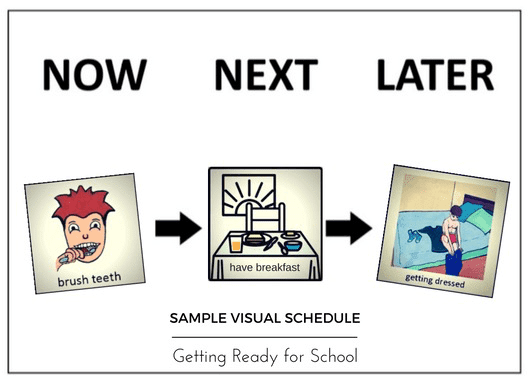
A first then visual is the simplest routine support: two boxes showing what needs to happen first and what follows, such as “first shoes, then park”. Put the less preferred task first and something motivating second. Once your child is comfortable with two steps, the First Then Next strip extends the idea to three steps for slightly longer sequences.
Visual schedules for the whole day
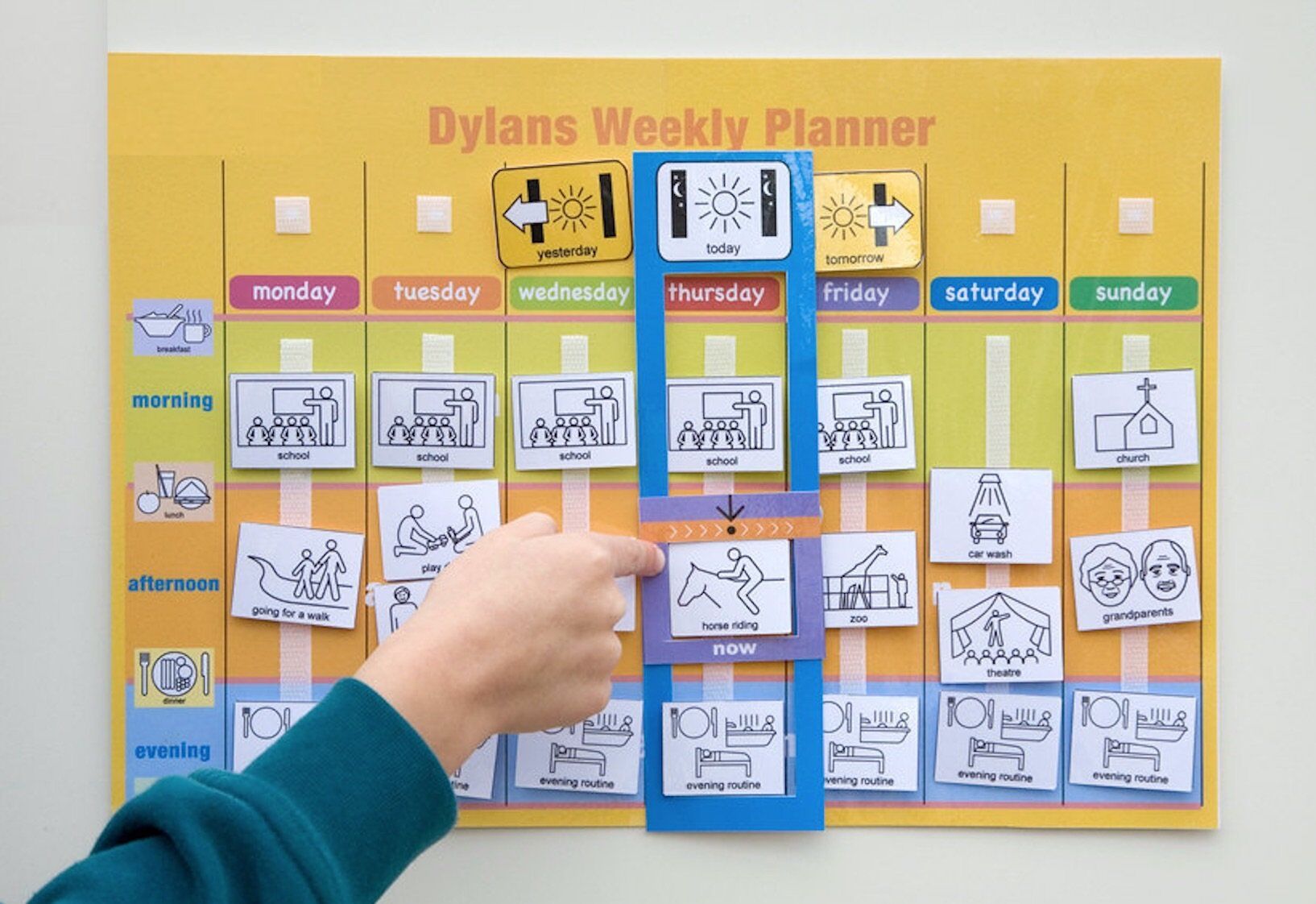
A printable visual schedule lays out a series of picture cards in order so your child can see the shape of the day. Most families use a strip of Velcro, moving or removing each card as it is finished. We also have ready-made schedules for the three busiest times of day:
- A morning routine visual schedule for getting up, dressed, fed and out the door.
- An afternoon routine visual schedule that breaks the after-school stretch into predictable steps.
- A bedtime routine visual schedule that walks through bath, pajamas, teeth and story in pictures.
Keep schedules short at first, three to five cards, and go through the schedule together before the routine starts. Point to the card, name it, do the step, then mark it as done.
Wait cards for the in-between moments
Waiting is abstract and hard to see. A wait card visual makes waiting concrete: your child holds the card while they wait and swaps it back for the thing they were waiting for. Start with waits of only a few seconds so success comes quickly, then slowly stretch the time.
Daily living skills: task analysis visuals
A task analysis breaks a self-care skill into small picture steps. “Get dressed” or “make your bed” sounds like one instruction, but it hides many steps. Showing each step makes the skill learnable and gives your child a way to do it more independently over time. These are some of the most popular visuals for autism we offer. For the bigger picture on teaching self-care, home and community skills, see our guide to life skills for autism.
Dressing visuals
- The getting dressed visual shows the full dressing sequence from start to finish.
- The putting on and taking off a shirt task analysis breaks the shirt into steps in both directions.
- The pants on and off visual includes tips like sitting down to start.
- The jacket on and off visual covers coats and jackets for school and outings.
- The tying shoelaces task analysis uses an eight-step loop, swoop and pull sequence that suits older children and teens.
Hygiene and household visuals
- The handwashing visual sits at the sink and breaks washing into picture steps for children, teens and adults.
- The brushing teeth task analysis covers an eleven-step tooth brushing sequence with tips on prompting.
- The shower visual for autism helps visual learners work through having a shower in order.
- The making the bed visual turns a long hidden-step instruction into a clear picture sequence.
How to teach with a task analysis
Two approaches work well. In forward chaining, your child learns the first step, then the first two, and so on. In backward chaining, you do every step except the last, which your child completes, so they always finish with success. Backward chaining is especially helpful for dressing and shoelaces. Whichever you use, point to the picture rather than repeating spoken instructions, and fade your help as your child gains confidence. Keep sensory needs in mind too: soap smell, water temperature, seams or tight cuffs can be the real barrier, not the steps themselves.
Behavior and regulation visuals for autism
Behavior is communication. Regulation visuals for autism help your child understand expectations, notice their own feelings and get motivating feedback, while helping you understand what is driving difficult moments.
Understanding why behavior happens
Before choosing a strategy, it helps to know what a behavior is doing for your child. Our functions of behavior infographic explains the four common functions (connection or attention, escape, sensory and tangible) and how to work out which one is behind a behavior. Pair it with the sensory processing and preferences visual to map out which sights, sounds, textures and movements calm or overwhelm your child.
Token boards and behavior charts
A token board shows progress toward something motivating. Your child earns tokens for a task and swaps a full board for the chosen reward. Start with the board almost full so the reward comes quickly, then slowly ask for more tokens. A visual behavior chart works in a similar way over a longer period. Keep both positive and strengths based: reward skills you want to build, and never use them to stop harmless stimming or to take away earned tokens.
Check In Check Out
The Check In Check Out visual supports short daily check-ins with one or two clear goals and warm feedback at the end of the day. It suits school-age children and works well when home and school use the same sheet.
Remember that the break card and wait card from the sections above are regulation tools too. Many families keep them on a key ring or lanyard so they are always within reach.
Social stories, sometimes called social narratives, are short, simple stories written from your child’s point of view that describe a situation, what usually happens and what people might do or feel. They were developed by Carol Gray and are widely used to prepare for new or tricky experiences such as a haircut, a doctor visit or a new classroom.
A good social story is short, uses positive and literal language, describes rather than lectures, and includes a picture on each page. Read it together several times before the event, when your child is calm, not in the middle of a hard moment.
Our social understanding visuals for autism put the same idea into a single page:
- The Hug Circle visual shows your child who they can hug, high five, wave to or not touch, making unwritten rules about affection and consent concrete. It is a gentle way to teach body autonomy and boundaries.
- The separation anxiety visual and tips support calm, predictable drop-offs at daycare or preschool with a consistent goodbye ritual your child can see and rehearse.
You can write your own social stories too. Use real photos of the place and people, keep it to four to eight pages, and update it as your child’s understanding grows.
Data sheets for parents and clinicians
Tracking what happens around a behavior turns guesswork into patterns. These printable data tools sit alongside your visuals. They are useful for parents, and they are the same kinds of tools clinicians and behavior support practitioners use, which makes sharing information with your team much easier.
- The ABC data sheet records the Antecedent (what happened just before), the Behavior and the Consequence (what happened after). A worked supermarket example shows how to fill it in.
- The frequency data sheet counts how often a behavior happens during a set time, so you have a baseline and can see whether a strategy is helping.
- The data review sheet extends ABC data with the steps you took, communication strategies used, what worked, what did not, and a section for discussion with your coach.
Collect data for a short, set period, such as a week, and look for patterns in time of day, place, people and demands. Often a clear trigger appears that a visual support can address directly. For a broader reference that pulls together teaching strategies, tools and where to find help, download the free Autism Special Needs Handbook.
How to print, set up and introduce visuals for autism
A few practical habits make printable visuals for autism last longer and work better.
Prepare them to survive real life
- Print on card stock and laminate, or use clear contact paper or plastic sleeves.
- Add a small square of Velcro to the back of each card so cards can be moved on a schedule, choice board or token board.
- Make two copies of the most used cards: one for home and one for the bag, car or school.
- Keep portable cards on a key ring or lanyard for outings.

Introduce one visual at a time
- Show the visual during a calm moment first, not during a meltdown.
- Model it yourself: point to the card, say the word, then do the action.
- Keep your spoken language short while you point, so the picture carries the message.
- Use it the same way every time, and share it with everyone who cares for your child.
Fade and grow
Over time, reduce how much you prompt so your child uses the visual more independently. Some visuals will become unnecessary as a skill is learned, while others, such as schedules and break cards, may stay useful for life. Many autistic adults still rely on calendars, lists and phone reminders, which are visual supports too.
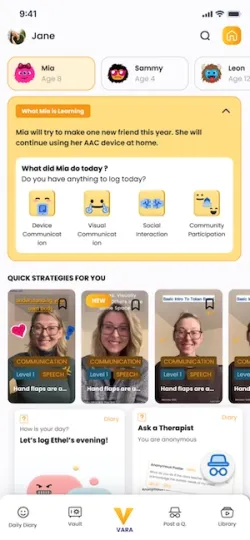
If you would like structured guidance on which visual to use next and how to fit it into your daily routines, the VARA parent-led autism program builds these strategies into a step-by-step plan for your family.
When visuals for autism don’t seem to work
If a visual is not landing, it is usually a matter of adjustment, not a sign that visuals are wrong for your child. Check these common issues:
- The symbol level is off. Try real photos instead of drawings, or the real object.
- Too much at once. Cut a schedule to three cards or a choice board to two options.
- The visual only appears during hard moments. Use it during calm, easy times so it becomes familiar.
- The promise is not kept. If a first then card says “then park”, the park needs to happen.
- The reward is not motivating. Let your child choose what they are working toward.
- The real barrier is sensory. Revisit your child’s sensory preferences and adjust the environment.
Give any new visual a few weeks of consistent use before deciding it is not right. Children often test a new system before they trust it.
Frequently asked questions about visuals for autism
What are visual supports for autism?
Why are visual supports important for autism?
Why do autistic people often respond well to visuals?
When should you use visuals with an autistic child?
Will using visuals stop my child from learning to talk?
How can I make visuals for autism for free?
When can visuals switch from pictures to written words?
Start using visuals with confidence
You do not need a full set of visuals for autism to begin. Choose one visual that targets your family’s biggest daily challenge, print it, introduce it during a calm moment and use it consistently. As it becomes part of your routine, add the next one from this library.
For step-by-step support that brings visuals, communication and daily routines together, download the VARA app from Autism 360. VARA guides you through practical, research-led strategies you can use at home, at your child’s pace, so the visuals you use fit into a clear plan.

I am Ash and I celebrate Neurodiversity! Growing up with an elder brother with severe Autism was tough – but it has also taught me essential life lessons. I don’t believe that people with Autism are necessarily or have any disorder (except in extreme cases). They are just different! And that is something to be proud of! I am passionate about helping other families who may have Autism conditions in their family. So please reach out and drop me a note. I will be glad to help 🙂