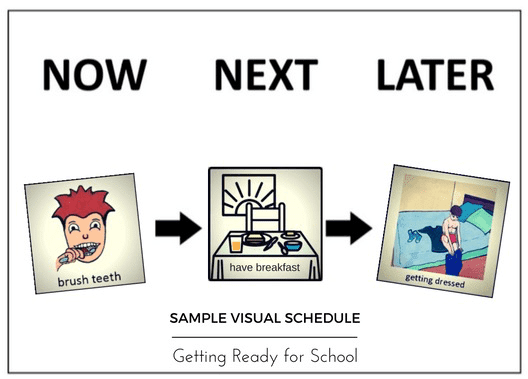

An Afternoon Routine Visual Schedule is a graphic representation of scheduled tasks and activities in a child’s afternoon routine. Daily routines can be stressful. Having a visual of the routine can make everyone’s day more manageable. The visual is great for breaking down tasks that have multiple steps so your child can work through their afternoon routine one step at a time. It shows them where they will be, when, and what comes next.
Key takeaways: visual schedule afternoon
- Show what is next. A visual schedule for the afternoon turns the routine into picture steps, so your child sees what comes next.
- Start short. Begin with three or four cards and add more once the routine feels familiar.
- Plan recovery time. Make a calm break or snack one of the cards, ideally near the start.
- Mark steps done. Let your child turn over, tick or remove each card so they can see how much is left.
- Listen to resistance. If your child resists, try a shorter routine, a preferred activity earlier, or a choice of two cards.
These printable cards are for children who find the after-school stretch hard and do best when they know what’s coming. Below you’ll find a video, the download, and a step-by-step guide to setting up the schedule and adapting it for your child. It sits alongside our other visual supports for autism, all free to print.
What is an Afternoon Routine Visual Schedule?
An Afternoon Routine Visual Schedule is a graphic representation of scheduled tasks and activities in a child’s afternoon routine.
Daily routines can be stressful. Having a visual of the routine can make everyone’s day more manageable.
Having a visual of the afternoon routine can help a learner stay on task as well as to help with transitioning from one task to the other by knowing what comes next. Predictable routines are especially helpful for a child who feels anxious about “what’s going to happen next”.
The visual is great for breaking down tasks that have multiple steps so your child can work through their afternoon routine one step at a time. It shows them where they will be, when, and what comes next.
It is typically a series of images, pictures, photographs, icons, words, or line drawings used to depict a sequence of events/tasks/activities to be done in the afternoon. This helps prepare the learner for the next activity, the next step of an activity or a sequence of activities.
The goal of an Afternoon Routine Visual Schedule is to help a learner understand what to expect during their afternoon. This reduces anxiety around transitions and supports children who thrive on predictability. If you are new to this approach, our guide to using a printable visual schedule covers the basics, and the same format works for a morning routine visual schedule and a bedtime routine visual schedule.
Some advantages of using a visual schedule are:
- Provide organization, structure, predictability and set up a clear routine
- Clarify expectations
- Redirect learner back to current activity
- Make transitions easier
- Reduce anxiety
- Teach independence, responsibility, and planning
- Avoid power struggles
- Provide concrete reminders; available to reference as often as needed
- Visual schedules can represent tasks, directions, routines, verbal requests, and more.
How to Use This Visual Schedule With Your Child
- Print and place. Print the cards and stick them in order somewhere your child passes often, such as the fridge or the back of their bedroom door.
- Start short. Begin with three or four steps and add more once the routine feels familiar. If a full schedule feels like too much, a three-step first then next schedule is an easy place to start.
- Build in recovery time. If your child is tired or overloaded after school, make a calm break, a snack or time with a favorite activity one of the cards, ideally near the start.
- Walk through it together. Go through the afternoon steps when your child gets home, pointing to each picture and using just a few words.
- Mark each step as done. As each task is finished, let your child turn over, tick or remove that card so they can see how much is left.
- Fade your prompts. Over time, point to the schedule instead of saying the step, then let your child check it on their own.
If your child resists the schedule
Look at what the resistance might be telling you. The routine may be too long for the energy your child has left after school, a step may be harder than it looks, or they may need more say in the order. Try shortening it, moving a preferred activity earlier, or letting your child choose between two cards for the next step. It also helps to note what you changed and how the afternoon went; if you track your child’s day in the VARA diary, patterns show up within a week or two instead of relying on memory.
Ways to Adapt the Schedule
- Non-speaking children and AAC users: Add the same words to their AAC device as the cards, such as “snack”, “play” and “bath”, so they can talk about the routine and ask for what comes next.
- Use real photos: Some children connect more with photos of their own snack, bag or bathroom than with drawings.
- Make it hands-on: Laminate the cards and use Velcro so your child can move each card to a “finished” pocket or envelope.
- Add a timer: Pair a card like “screen time” or “play” with a visual timer so the end of the activity isn’t a surprise.
- Plan for changes: Keep a “change” or “surprise” card ready for days when the routine is different, such as a doctor’s visit, and use place visual cards to show your child where you are going.
Frequently Asked Questions
What age is an afternoon visual schedule for?
There’s no set age. Picture schedules are common with preschool and primary-age children, and older children often move to a written checklist using the same idea.
How long until my child gets used to a visual schedule?
Many children start to follow a visual schedule within a couple of weeks of using it every day, but every child is different. Using it consistently, even on good days, makes the biggest difference. 

Rachael Young is a behavior analyst with Autism 360, specializing in tailored, evidence-based support that improves daily life for children and their families. She is an Adjunct Instructor at Arizona State University, where she trains the next generation of behavior analysts, and is completing a PsyD in Clinical Psychology to deepen her clinical practice. Rachael is proud to identify as neurodivergent, and that lived perspective shapes the empathy and practicality of her work. She writes about ABA, autism in girls and women, co-occurring conditions and the teen years.