
Assistive technology for autism refers to tools, devices and software that support autistic people with communication, learning, social connection, sensory regulation and daily living. Examples include speech-generating devices, tablets with autism apps, picture boards, visual schedules, weighted blankets, noise-canceling headphones and educational software. These assistive devices for autism help autistic people communicate, manage sensory sensitivities, learn in ways that suit them, build independence and take part fully in everyday life.
Autism is common. In the US, the CDC estimates that around 1 in 31 children is autistic, and autism affects people of all ages, cultures and backgrounds. Autism is a lifelong neurodevelopmental difference, and its causes are still being researched.
Children with autism may need extra support to take part fully at school and in social settings. Parents, carers and educators can do a lot to help, and there are many assistive technologies that adapt the environment to the child, so each autistic person has the chance to reach their full potential.
This article explains assistive technology and autism: the main types of assistive technology devices for autism, and how they can help autistic children, students and adults, and their families, with more confidence.
Understanding the Autism Spectrum
Autism, also known as Autism Spectrum Disorder (ASD), is a lifelong developmental difference that mainly affects sensory processing, behavior and social communication. Every autistic person has a different mix of strengths and challenges.
Core traits of autism can include differences in expressing and reading emotions, different ways of building and keeping relationships, deep interests and repetitive behaviors, and lower or higher sensitivity to sensory input.
Autism is usually diagnosed in early childhood, although many people are diagnosed later. It’s called a spectrum because autistic people have a wide variety of strengths and support needs. Some need a little support in some situations, and others need a lot of support every day.
Autism can bring real challenges in different settings, and many autistic people also have unique skills, talents and abilities. With early support, therapies and adjustments that fit the person, they can thrive.
What is Assistive Technology?
Assistive technology includes any equipment, whether bought, customized or modified, that improves or maintains the everyday abilities of people with disability.
An assistive technology device can range from simple items such as pencil grips, magnifying glasses and hearing aids to complex tools like computer software, powered wheelchairs and speech-generating devices that support learning, communication and executive function.
Assistive technology has many benefits, from increasing independence and productivity to improving quality of life for children with disability, including autistic children. It removes barriers they face in day-to-day life.
Assistive technologies can be adapted to meet each person’s needs in a wide range of settings, including home, work, school and social situations.
At school, these tools help students take part in activities, learn in ways that suit them and work towards their academic goals.
Although we call it technology, assistive technology can be low-tech (like sunglasses, fidget toys and specialized chairs) or high-tech (like adaptive keyboards, apps for autism and robots).
Because every autistic child has different strengths and needs, what works for one child might not work for another. Schools and teachers should consider each student’s specific needs when bringing assistive technology into the classroom, and talk with parents (and the student, where possible) to make sure the tools chosen are a good fit.
Assistive Technology Examples:
Examples of assistive technology include tools and devices that help people with disability do everyday tasks more independently and effectively. Some common examples are:
1. Low-tech devices: Pencil grips, picture boards, visual schedules, communication books, weighted blankets, fidget toys.
2. Mid-tech devices: Electronic timers, visual timers, video modeling, sensory toys, simple speech-generating devices.
3. High-tech devices: Tablets with apps for autistic children (like LAMP Words for Life and Proloquo2Go), speech-generating devices, adaptive keyboards, text-to-speech software, AAC devices.
4. Safety and daily living tools: GPS trackers, ID bracelets, adapted utensils, noise-canceling headphones, smart home aids.
These tools support communication, learning, sensory regulation, social connection, executive functioning and overall independence for autistic people and people with other disabilities.
How Assistive Technology for Autism Helps
Autistic children can use assistive technologies to reduce barriers that affect how fully they can take part in daily life, including social interaction, communication, executive functioning and sensory processing.
For instance, autistic people who communicate differently or don’t use speech may use communication tools such as the Picture Exchange Communication System (PECS) or speech-generating devices. These help them express their thoughts, feelings, needs and wants, which improves their daily interactions with others.
Other people with autism experience sensory processing differences and can use sensory tools such as noise-canceling headphones, sensory swings or weighted blankets to reduce anxiety and regulate sensory input.
Assistive technology also helps many autistic people take part more effectively at school or work, through tools such as educational apps, motivation tools and organization programs that help them manage tasks and stay on track.
Types of Assistive Technologies for Autism
Types of Assistive Technologies for Autism
Assistive technology, including autism assistive devices, can be grouped into three types:
- Low-tech assistive technology: anything that doesn’t need electricity, including picture boards and visual schedules.
- Mid-tech assistive technology: simple, affordable, easy-to-use devices such as visual timers, video modeling and sensory toys.
- High-tech assistive technology: modern technology, including augmentative and alternative communication (AAC) devices for people who are non-speaking or minimally speaking.
Assistive Technology for Communication
Communication devices are one of the most popular types of assistive technology. They include picture boards, the Picture Exchange Communication System (PECS), speech and language apps, and speech-generating devices.
Communication picture boards are simple boards with images and symbols that non-speaking (nonverbal) autistic children can point to, to share their needs, thoughts and feelings. Children who are learning to talk, or who find speech hard at times (for example when stressed), can use them too. Printable visual communication cards work the same way and are an easy place to start at home.
Autistic children can also benefit from AAC and speech-generating apps such as TouchChat HD, Autism Talk Now and Proloquo2Go, which give them a voice and can support language development.
For example, TouchChat HD offers multiple language options and lets children choose a voice that suits their personality. Proloquo2Go includes more than 10,000 words, works in several popular languages and can be customized to suit a child’s thinking and physical needs.
Using AAC does not stop children from learning to speak. Research shows it often supports speech and language development. Other apps support language and speech practice, such as the well-regarded LAMP Words for Life (an AAC system) and Articulation Station (a speech practice app). Apps work best alongside speech therapy for autistic children, so share what you are using with your child’s speech pathologist.
Whichever system you choose, consistency matters more than which brand it is. Speech pathologist Stacy Badon, who coaches Autism 360 families, suggests deciding with your child’s therapist whether to use pictures, AAC or a mix, then using that method as consistently as possible across settings. “If you accept your child’s method of communication, even if it looks different from the other kids, your child will thrive.”
How can you build AAC into everyday routines at home?
A device that sits in a cupboard between therapy sessions won’t get used. Pick one routine your child enjoys, such as snack time, and make the AAC device or picture board part of it every day: keep it within reach, model a word on it yourself before you expect your child to, and respond straight away to any press or point. Add a second routine only when the first feels easy. If you get stuck on how to model or which words to add, VARA’s AI parent coaching gives you guidance between appointments on applying a strategy in everyday moments, so you feel confident you are doing it right. Your speech pathologist still sets the plan; the coaching helps you carry it out at home.
 AI parent coaching
Assistive Technology for Executive Functioning and Learning
Studies suggest that around a third of autistic children also have an intellectual disability. Research also shows that roughly 40 percent of autistic people have an anxiety condition, and a similar proportion have attention deficit hyperactivity disorder (ADHD).
These co-occurring conditions, along with some symptoms of autism, can create challenges at home, at school and at work. Common learning challenges include:
- Processing written and spoken language, including some math topics and word problems
- Sensory sensitivities to certain sounds or lights, which can make it hard to sit still in a classroom or workplace
- Executive function differences that make it hard to plan projects, manage schedules or stay on track
Assistive technology for executive functioning can help autistic people with these challenges, at home, at school, at work or anywhere else.
Attention, organization, planning and finishing tasks are all executive function skills, and when they are hard, independence and quality of life can be affected. Assistive technology for executive functioning is designed to fill those gaps and increase independence. Examples include visual timers, visual schedules, calendar systems and wearable reminders that help with multi-step tasks.
Assistive Technology for Social Skills
Some apps are designed to help autistic children practice social situations in a low-pressure way.
For example, The Social Express uses animated stories to explore how to start and keep up two-way conversations. Social skills tools work best when they respect the child’s natural way of connecting, rather than training them to mask or copy neurotypical behavior.
Assistive Technology for Sensory Challenges
Assistive Technology for Sensory Challenges
Many autistic people are over-responsive or under-responsive to sensory input. A child might find loud noises overwhelming but barely notice a bump or scrape.
Occupational therapists often use sensory approaches, including sensory integration therapy, to help children regulate, and parents, teachers and other adults can use assistive technology tools to help calm the nervous system.
Occupational therapists commonly use low- and mid-tech tools such as therapy balls, brushes, swings and trampolines.
Teachers and other professionals can offer tools such as tinted glasses and noise-canceling headphones to help autistic students manage light and sound. Parents and educators can also use weighted blankets or ball pits to provide calming deep-pressure and touch input.
Sensory toys for autistic children can help kids calm down, relax and focus, alongside other evidence-based supports.
Common types of sensory toys include:
- Vibrating gadgets or cushions, which some children find calming and organizing
- Fidget spinners and fidget toys, which can help some children concentrate by keeping their hands busy
- Sand or slime, which can be soothing and helps practice fine motor skills
- Rainmaker toys, which may help children calm down
Apps can also provide sensory breaks, with activities such as calming visuals, music or following moving pictures with the eyes. Although they weren’t built specifically for autistic children, many find them helpful. They include Heatpad, Brainworks and Miracle Modus.
Assistive Technology for Modeling Social Situations
Many autistic children read non-spoken social cues, such as tone of voice, gestures and facial expressions, differently from their non-autistic peers. Children learn a lot by watching and imitating, so video modeling (watching short videos of a skill or situation) can help them understand what to expect and try new skills at their own pace. It’s most useful for practical things, like what happens at the dentist or how to join a game, rather than for changing who a child is.
There are many programs available to support this, including Talking Mats, The Social Express and Autism & Beyond.
Assistive Technology for Scheduling
Assistive technology can help autistic people stay organized with daily tasks like brushing teeth, taking medication or doing homework. Scheduling apps can help them keep track of everyday activities.
Commonly used scheduling apps and tools include Time Timer, iDO and myHomework Student Planner.
Assistive Technology for Motivation
Many children, autistic or not, find motivation easier when tasks feel meaningful and success is noticed. Positive reinforcement can be a helpful way to build motivation, especially when it’s linked to a child’s interests.
There are many apps with built-in reward systems that help children stay on track.
Popular motivation and learning apps include ABA Flash Cards HD, Zoolingo, Autism iHelp and Task Analyzer.
Assistive Technology for Writing
Assistive technology for writing can support autistic children at every step, including planning, generating ideas, writing (or typing) and proofreading. Even children who can’t yet spell simple words or hold a pen can still become accomplished authors!
Assistive technology for writing includes low-tech pencil grips, adapted paper and graphic organizers, mid-tech voice recorders and symbol-based writing tools, and high-tech AAC devices that support the whole writing process.
Other examples are word prediction, voice typing (speech-to-text programs), word banks, mind-mapping tools and graphic organizers.
Assistive Technology for Reading
Reading is a big part of school learning and involves several skills, including positioning the book, reading text and pictures, understanding what you read, and scanning many words and complex sentences.
Assistive technology for reading includes slant boards for holding books, reading windows to reduce distractions, audiobooks, and text-to-speech programs that read words aloud.
Assistive Technology for Play
Some autistic children develop fine motor skills on a different timeline and find it harder to manipulate small toys. If your child finds motor coordination hard, adapted toys with bigger handles, switch-adapted toys and easy-grip play items can help them join in and build these skills through play.
Assistive Technology for Safety
Many companies offer tracking devices, ID cards, bracelets and tags with important personal details such as name, contact information and address, and some can quickly connect children with their families. Examples include Project Lifesaver International, AWAARE and Alert Me Bands. These products are fairly similar, so choose based on price and your family’s needs, and check which ones are available where you live.
Assistive Technology for Adults with ASD
Assistive technology isn’t only for children. Technology solutions for adults with ASD include noise-canceling headphones for busy workplaces, calendar and reminder apps for executive function, text-based communication (email, chat or AAC) for days when speech is hard, budgeting and meal-planning apps, and smart home tools that make daily living routines easier. Many autistic adults also use assistive tech for autism to manage energy and avoid burnout, for example by scheduling breaks and quiet time. Some also use an autism dating app to meet people in a setting where clear, direct communication is the norm.
Funding Assistive Technology in Australia
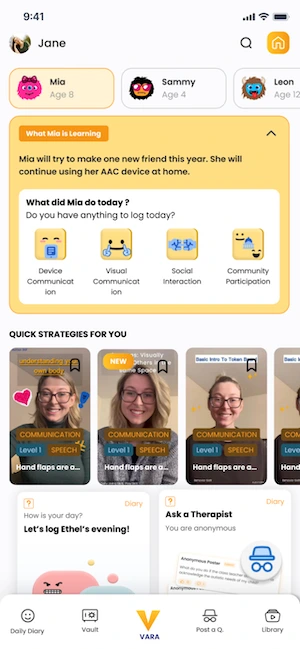
In Australia, the NDIS can fund assistive technology for autism when it relates to a participant’s disability support needs and goals. Low-cost items can usually be bought from a participant’s core budget, while more expensive or complex items, such as some speech-generating devices, often need an assessment and quote from an allied health professional, such as a speech pathologist or occupational therapist. Before buying an assistive device for autism, ask a therapist whether your child can trial it first. If your child doesn’t have NDIS funding, ask your school about devices they can provide, and look for free or low-cost apps and printable visual supports to start with. For support at home while you wait for funding or therapy, the VARA app lets parents track their child’s day and ask an autism therapist questions.
Benefits of Assistive Technology for People with Autism
Benefits of Assistive Technology for People with Autism
Assistive technology offers many benefits to children with autism and their families. It supports social interaction, communication, sensory processing, executive functioning and independence, and improves quality of life for autistic people every day.
For social interaction and communication, speech-generating devices allow many speaking and non-speaking people to share their thoughts and feelings more easily.
Another key benefit is confidence. Autistic people can feel frustrated and discouraged when a barrier stops them from completing a task. Assistive technologies provide the support they need to do tasks that would otherwise be frustrating or out of reach, which builds confidence.
Assistive technology can also support interpersonal skills, helping autistic people take part more in school, work and social settings, and further boosting confidence and self-esteem. Many of the same tools also help people with ADHD and related conditions.
In short, assistive technology for people with autism contributes to:
- More engagement in daily tasks and routines
- Better access to learning materials and other resources
- More self-confidence and self-esteem
- More opportunities for acceptance and inclusion with peers
- More engagement in meaningful activities
- Stronger spoken and non-spoken communication
- More chances to show their skills and talents
- More independence in daily living, getting around, learning, play and work
How Assistive Technology in the Classroom Helps Autistic Students?
Assistive Technology in the Classroom
Assistive technology for autism in the classroom helps autistic students with communication, learning and social engagement from day one. It helps them take part more fully in lessons, express themselves, manage sensory sensitivities and build independence, while accommodating the way they learn. Tools range from low-tech visual aids and communication boards to high-tech speech-generating apps and organization software, all designed to support learning and confidence.
Autism diagnoses have been rising, and as more children are diagnosed, schools need to be ready for more requests for adjustments.
Early diagnosis and support can improve learning outcomes, and an autism diagnosis should never stand in the way of a high-quality education. Building assistive technology into school programs early helps autistic students adapt to changing school and classroom environments. Schools can help autistic students reach their academic goals, and help more of them finish secondary and further study, by making assistive technology and other resources easy to access.
Assistive technology for students with autism supports a wide variety of learning needs. Good technology for autistic students helps them communicate with teachers and classmates and take part fully in learning.
With more hybrid and remote learning around the world, the need for assistive technology is only likely to grow. Combine different tools to meet each student’s needs and support their independence at home and at school.
Access matters as much as the tool itself. Stacy Badon encourages parents to meet with the school, ideally with the speech therapist, and agree that pictures, AAC or core boards are available to the child at all times, not only in set lessons. As she puts it, “School staff should not be deciding when your child needs to communicate.”
How can you show the school which tools help at home?
Teachers are more likely to keep a tool going when they can see it working. For a few weeks, jot a quick note each day about which tools your child used at home, when they reached for them, and what happened next, for example a visual timer that made homework easier or headphones that helped at the shops. VARA’s Daily Diary keeps these quick daily notes, and short, messy entries are fine. Insight Reports then turn your diary entries into patterns and progress over time that you can share with your child’s clinician, school or a new provider, which gives you something concrete to bring to an IEP meeting or a request for a device trial.
Insight ReportsFAQs on Assistive Technology
What is Assistive Technology in Special Education?
How Can Digital Assistive Technology Help Students?
What is Low Tech Assistive Technology?
What is High Tech Assistive Technology?
Conclusion
Assistive technology can make things that seemed impossible possible. Technology benefits all of us, and for many autistic people, assistive technology for autism spectrum disorder is a way to take part, show what they are capable of and live more independent lives.

Stephanie Collins is Head of Program Delivery and a founding member of Autism 360, and the company’s US spokesperson. Based in Colorado, she is a parent of two autistic children, so she brings both professional and lived experience to her work. Stephanie is a behavior support practitioner and developmental educator with more than 15 years in special education, and she is certified in American Sign Language. She is a well-known community advocate for the needs of autistic girls, and has been interviewed on the topic by news channels including Fox, Channel 9 and Channel 5. Stephanie writes about sensory differences, communication, schooling and ADHD.