You’re towards the tail end of the reporting process and you’re waiting on the final positive behavior support plan. But you’ve found yourself wondering: what does a good support plan actually look like? It’s a fair question. A positive behavior support plan (often called a PBS plan or behavior support plan) guides everyone in your child’s life on how to understand and support them, so it’s worth knowing what quality looks like. Here are the things to look out for.
What is a positive behavior support plan?
A positive behavior support plan (PBS plan) is a written, person-centered plan that explains why behaviors of concern happen and how to support the person. It covers the function of each behavior, changes to the environment, skills to teach, how to respond calmly, and how progress and quality of life will be measured. Under the NDIS, it is written by an NDIS behavior support practitioner.
What is a PBSP?
PBSP stands for positive behavior support practitioner. Under the NDIS, a PBSP is a behavior support practitioner who works with the person, their family and the people who support them to understand why behaviors of concern happen and what needs those behaviors are communicating. They then write the behavior support plan, with practical strategies such as changes to the environment, routines and communication supports, that aim to improve quality of life and reduce the use of restrictive practices. A good PBSP works with you, not on your child.
Positive behavior support plan checklist: 8 key items
While you wait for your final plan, use this quick checklist. A quality positive behavior support plan:
- Identifies the function of each behavior of concern before it suggests any strategies. Under the NDIS, this understanding comes from a functional behavior assessment, which the practitioner completes before writing the plan.
- Includes sensory considerations, so the environment is adjusted first.
- Draws on multidisciplinary consultation. If your child sees a speech pathologist, occupational therapist or psychologist, or their school is involved, the practitioner should talk with them and build what they know into the plan. Your own knowledge as a parent or carer belongs in there too.
- Uses no consequence-based methods, but still explains how to respond calmly to behaviors of concern.
- Includes skill-building strategies that teach a new way to meet the same need.
- Includes measuring and monitoring, with a timeline for when behaviors of concern and quality of life will be re-measured.
- Uses recognized assessment tools. The practitioner should gather information with you using established questionnaires, surveys and behavior recording templates, not guesswork.
- Is reinforcing and positive for the participant, built around their strengths, interests and preferred way of living.
A good plan should also include a training plan, so you and everyone supporting your child know how to use it. Each of these items is explained below.
The positive behavior support plan identifies the ‘function’ of the behaviors of concern
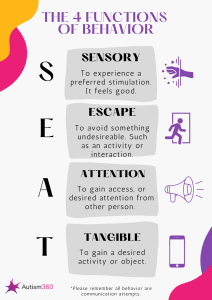 A quality positive behavior support plan will include an in-depth focus on the ‘functions’ of each behavior of concern. Understanding behavior comes before developing strategies, and it is a major aim of positive behavior support plans. Behavior is communication: the plan should explain what each behavior is telling us.
So a great support plan will discuss each behavior through a lens of:
- Does this behavior serve the purpose of sensory integration?
- Does it serve the purpose of escaping a situation?
- Or to connect with, or get attention from, another person?
- A means to gain access to a tangible item?
- Lastly, maybe even a combination of a few, that can also change on each occasion?
Here are a few examples of what investigating the function of behavior can look like:
- A child turns their music up loud every day after school. After a big day full of sounds they can’t control, and with younger siblings shouting at home, a familiar song gives them a moment of predictable sound. The function is sensory.
- A non-speaking woman in a busy respite house throws her cup across the room after each drink. Above the noise of the house, she has found this is the clearest way to show staff she is finished and ready to go back to her room. The function is communication.
- A school says a boy is “avoiding” assembly. Looking closer, crowds feel scary and draining for him, so he hides before assembly time. The behavior meets a real need; it isn’t simple avoidance.
A practitioner should spend plenty of time on the “why” before suggesting strategies. If they jump straight to what they “will do”, that is one of the red flags to watch for.
Sensory considerations are included within the support plan

You or your child may not have identified sensory processing differences, but let’s face it, all of our days are shaped by sensory input. We all seek more of some input and less of other input to stay regulated. For example, after a long day at school your child may want quiet from people, head to their room and play loud music. That isn’t rude or antisocial. It can be a sign they are overstimulated, need a break from conversation and are using music to block out other noise and settle their body. These actions are self-regulation and sensory regulation strategies, and they are worth protecting.
A good behavior support plan recognizes these needs, respects your child’s routines and builds sensory considerations into everyday strategies. An occupational therapist can help with this too, and NDIS occupational therapy for autistic children often focuses on exactly these sensory needs at home.
How could this look?
- When picking up your child from school, offer them headphones straight away to help them manage sensory input
- Avoid overloading them with questions about their day straight away
- Keep supporting their music time in their room when they get home
Choose a positive behavior support practitioner who recognizes the function of behavior and prioritizes meeting that need in their plan.
No ‘consequence-based’ methods are used within the PBS plan
In a great positive behavior support plan, we don’t want to see ‘consequence-based’ methods. A consequence-based method looks something like: “When they do this behavior, remove their screen time for a week.” Punishments like this don’t teach your child what to do instead, they don’t meet the need behind the behavior, and they can damage trust between you. They don’t align with positive behavior support, which is all about building skills and making life better.
Of course, a good plan will still tell you how to respond to behaviors of concern, but in a calm, constructive and strengths-based way. An effective behavior support plan is proactive. It helps you spot the early signs and triggers for behaviors of concern before they happen, and it gives you behavior support strategies to put in place beforehand, so the behavior is less likely to happen at all. When the environment and the supports around your child are right, there is far less need to talk about consequences, because your child has been helped to stay regulated in the first place.
It includes skill-building strategies
If a great plan DOESN’T use ‘consequence-based’ methods, what should you look for instead?
You want the plan to include quality teaching strategies. Throughout the plan, each behavior of concern should come with a goal for teaching the person a new skill that meets the same need, and clear guidance on how to teach it.
This information should be located under the ‘Functionally equivalent replacement behavior’ and ‘Behavioral goals’ sections for each listed behavior of concern.
And could look something like this:
- Provide expressive language opportunities: this can be through AAC or PECS, sign language, gestures or spoken scripts. All of these are real communication. For example, the following messages would be useful to practice with the participant:
- “Stop”
- “Help”
- “My turn”
- “Can I ____”
- “I want ___”
- Followed by a further breakdown on how the opportunities can be practiced, and how to respond to and reinforce the participant’s attempts.
The positive behavior support plan includes measuring and monitoring
Positive behavior support plans give you A LOT of information! Once you’ve read through the plan (perhaps more than once), check that it includes a clear action plan for measuring progress in the future. We want to see how they plan on monitoring and re-measuring the behaviors of concern AND the participant’s quality of life. For example:
For behaviors of concern: A quality plan is built on behavioral data the positive behavior support practitioner collected with you at the start of the journey. Ideally, we can count how often the behavior is occurring to let us know if the strategies are working. Sometimes, this isn’t feasible, so we may use questionnaires or assessment tools instead. A great positive behavior support plan includes suggestions on when and how these tools should be used AGAIN to re-measure the behavior in the future.
For quality of life: We want to see how the initial (baseline) measures of the participant’s quality of life will be re-measured. Regularly checking in on independence, skill development, wellbeing and social connection shows whether life is genuinely getting better, not just whether a behavior has reduced.
Without re-measuring, we don’t have ‘hard’ data on just how well the plan is assisting the participant.
It includes a training plan
A plan only helps if the people around your child know how to use it, which is why every positive behavior support plan should include training. Many behavior support approaches are carer-led: the practitioner teaches skills and strategies to the people who spend the most time with the person, rather than only working with the person directly. This matters because:
- There are more chances to practice. A large PBS allocation might be around 120 to 130 hours, which is only about 2.5 hours a week of in-person time before report writing and travel are counted. Families and carers can practice every day.
- Skills carry over to real life. Carers can practice in the places, and with the people, that matter most to the person. That is how new skills generalize.
- Carers are experts too. You know your child best, so you can work with the practitioner to choose the strategies that fit your day-to-day life and come up with new ones.
- Consistency lowers anxiety. When family, teachers, support workers and respite staff are all trained in the same plan, everyone responds in a predictable way, which helps the person take up new skills.
Training in a plan might include ongoing support from the provider who wrote it, de-escalation or trauma-informed training through a third party, and education on how to reduce, and work towards eliminating, restrictive practices.
What if your plan doesn’t include training?
It happens more often than you’d think. When the NDIS Quality and Safeguards Commission reviewed behavior support plans submitted to it, only 45% had a fully developed training plan, 17% had a partial one and 38% had none at all. Training is usually funded in NDIS plans, often listed as “Behaviour Management Plan Including Training in Behaviour Management Strategies”, and your practitioner should tell you how much time they will set aside for it and how they usually deliver it.
If training is missing, ask your practitioner why, and ask them to revise the plan to include it. It is best practice to give you or the participant the draft plan for feedback before it is submitted to the NDIS, so you should have the chance to ask. If a practitioner doesn’t give you that chance, treat it as a red flag.
It’s reinforcing and positive for the participant
When you read the support plan written for you, it should leave you feeling positive and clear about what to do next. If the plan is for your child, you should feel the same way. A great behavior support plan includes positive strategies and a clear, hopeful direction for the participant.
So let’s break this down:
Reinforcing qualities: A reinforcing positive behavior support plan builds in the participant’s preferred activities, interests and way of living. Your practitioner should understand your family’s needs and circumstances, so the plan is practical for your real life, not unrealistic (because that would be demotivating). It should also use the things your child loves as natural motivators.
Positive qualities: A positive plan uses neuroaffirming, person-centered language and describes the participant’s challenges respectfully and honestly. To create a positive behavior support plan, practitioners should use a strengths-based approach that highlights the participant’s strengths, interests and abilities. Reading about yourself or your child this way builds confidence and gives everyone a clear sense of direction.
Positive behavior support examples
Here are some positive behavior support examples that show how a good plan turns understanding into everyday strategies:
- Morning routine distress: if getting ready for school often ends in a meltdown, the plan might suggest a visual schedule, laying out clothes the night before and building in extra time, rather than rushing or adding pressure.
- Leaving the park: if your child hits out when it’s time to go, the plan might use a five-minute warning, a timer and a “first park, then snack” visual, plus teaching a way to ask for “one more minute”.
- A noisy classroom: if your child runs out of class, the plan might give them a break card, access to a quiet space and noise-reducing headphones, so they can ask for a break instead of needing to escape.
- Waiting for a turn: if waiting leads to grabbing, the plan might teach “my turn” with a visual and practice turn-taking in fun, low-pressure games first.
In each example, the strategy changes the environment first, then teaches a skill that meets the same need. That is the heart of supporting positive behavior.
Positive behavior support for autistic children
Good positive behavior support autism families can trust starts from how your child experiences the world. Sensory differences, communication differences, anxiety and unexpected changes to routine sit behind many behaviors of concern. A good positive behavior plan doesn’t try to make your child look less autistic, stop harmless stimming or force eye contact. It aims to reduce distress, build communication and help your child take part in the things that matter to them and to your family. Our psychology and behavior support for autistic children follows the same approach, working with families at home.
Positive behavior support NDIS: what parents should know
Under the NDIS, an NDIS behavior support plan is written by an NDIS behavior support practitioner, and the NDIS Quality and Safeguards Commission oversees behavior support. A few things are useful to know:
- NDIS behaviors of concern: the NDIS uses “behaviors of concern” to describe behaviors that put the person or others at risk of harm, or that limit the person’s quality of life.
- Funding: behavior support is usually funded from the Improved Relationships category in the Capacity Building part of an NDIS plan. If you aren’t sure, check with your support coordinator or planner, and before your next review, read up on how to prepare for an NDIS plan review.
- Restrictive practices: if a plan includes a regulated restrictive practice, extra NDIS Commission rules apply, including lodging the plan with the Commission. The aim is always to reduce and remove restrictive practices over time.
- Your input matters: the positive behavior support plan NDIS participants receive should be written with you, not just for you. You know your child best, so ask questions and ask for changes if something doesn’t fit your family.
For more information on the framework that NDIS positive behavior support follows, see the NDIS Quality and Safeguards Commission website here.
How to find the right positive behavior support practitioner
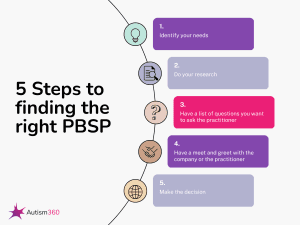
If your NDIS plan includes behavior support funding, these five steps can help you find a practitioner who fits your family:
- Identify your needs. Do you want face-to-face home visits, or could an online practitioner work for you (you still see them on screen and save on travel costs)? Do you have a preference about the practitioner’s gender, since they may be coming into your home? Does your child have sensory needs or their own input to consider? Do you need someone with experience in a particular area, such as adolescence, autism, alternative communication (AAC) or specific behaviors?
- Do your research. Look through providers’ websites and social media to get a feel for what they stand for. Ask your support coordinator, psychologist, OT or case manager who they would recommend. Then check that the practitioner is registered and approved by the NDIS Commission, because an unregistered provider may not be able to claim against your NDIS plan, which could leave you paying. You can check using the NDIS Commission’s behavior support practitioner search.
- Write a list of questions. For example: do they have experience with all of your child’s diagnoses? Can they work with sensory preferences (such as avoiding strong perfume or loud voices) or allow extra processing time? Are they available on the days and times that suit you? What is their experience? Are there cultural or religious considerations that matter to your family?
- Have a meet and greet. Most providers offer a first meeting, in person or online. Bring your questions and take notes so you can look back on them later.
- Make the decision. If a practitioner feels like a good fit for your household, let them know and ask what they need from you to get started. If no one feels right, it’s okay to go back to the drawing board. Work out why it didn’t feel right, and you’ll know what to look for next time.
Red flags to watch for in a positive behavior support practitioner
- There’s no collaboration. Parents, carers and participants know the person best. Be wary if a practitioner brushes off your concerns (“Oh, that’s just hormones”), dismisses your view of why a behavior happens (you say “I think she’s anxious about school” and they reply “or she just wants to stay home and play”), insists on strategies that don’t fit your family, or offers generic suggestions before getting to know the person and their history. If you’re unsure, ask how they will involve you and the participant, for example by collecting data with you, asking for regular feedback and checking in with the participant at each step.
- They focus only on the behavior. The heart of PBS is that when stressors reduce and quality of life improves, behaviors of concern reduce too. No person needs fixing, but circumstances often do. Watch for judgmental labels like “revenge”, and for plans where the answer is simply for your child to give in and comply with what is socially expected.
- The function of the behavior isn’t discussed. If you hear a lot about what the practitioner “will do” before you hear how they will work out what help is actually needed, that’s a red flag. Understanding the why comes first.
All NDIS behavior support practitioners must follow the NDIS Code of Conduct.
We hope this helps!
If you want to know a little more about the next step, see our five steps to finding the right PBSP above.
And if you think an Autism 360 positive behavior support practitioner is the right fit for you or your child, or you’d like more information about Autism 360 and the two service models we offer (parent coaching and positive behavior support plans), book a call with us here to discuss the start of your journey.

I am Ash and I celebrate Neurodiversity! Growing up with an elder brother with severe Autism was tough – but it has also taught me essential life lessons. I don’t believe that people with Autism are necessarily or have any disorder (except in extreme cases). They are just different! And that is something to be proud of! I am passionate about helping other families who may have Autism conditions in their family. So please reach out and drop me a note. I will be glad to help 🙂