



If you are wondering what to do while waiting for autism assessment or other support, start at home now and keep every referral moving. Pick one small thing to try inside a routine you already have, and write down what you notice. You do not have to wait, and you do not have to stop seeking help.

Your Two Week Checklist
This checklist turns the two week plan on this page into small steps you can tick off, and it saves your progress on your own device.
Interactive checklist: small steps to tick off, with one list for families just starting out and one for families already on the NDIS.
Key facts
- You can start at home today. The Australian Government says you don’t need a diagnosis to access Thriving Kids supports.
- In trials, the clearest benefit of parent-led programs is in how parents and children interact. Results for other outcomes are mixed, and some trials found no effect.
- A government-commissioned guide for families says children learn best through daily routines such as mealtimes, play and getting dressed.
- Short notes with dates and real examples help the clinicians you see later.
- National phoneline: 1800 882 436, 7am to midnight Australian Eastern time, 7 days including public holidays. Thriving Kids Autism Helpline: 1300 654 789, Monday to Friday 8am to 7pm.
Facts checked against government sources on 13 October 2026.
Do You Have to Wait for a Diagnosis Before You Start?
No. You can start at home today, and some supports are open without a diagnosis. The Australian Government says you don’t need a diagnosis to access Thriving Kids supports, which started in October 2026 and are growing over time. As at 13 October 2026, the NDIS says its early childhood approach is for children younger than 9 with developmental delay or disability, and that a child does not need a diagnosis for its early childhood partners to help.
Starting at home does not mean stepping back from professional help. Stay on every waitlist. Keep the referral moving. Ask your GP whether any therapy can start during the wait. Our guide to talking to your GP helps you prepare for that appointment.
If your worry is about autism, see Thriving Kids and autism. For the whole program in plain English, start at our Thriving Kids hub. The official Thriving Kids hub (run by Raising Children Network) lists the government resources.
What Does the Research Say About Parents Supporting Development at Home?
It says parents can change how they and their child interact, and it is much less certain about anything beyond that. The trials below tested programs where a trained clinician coached the parent. None of them tested a parent working alone from a web page like this one. Here is what each found, including the ones that found no effect.
What Has Been Shown?
The steadiest finding is about connection. In the Cochrane review and in the PACT and JASPER trials, the way coached parents and their children interacted improved. A 2020 Australian research synthesis by Autism CRC, commissioned by the NDIA, reported that when caregivers were actively involved, effects were similar and at times greater. Autism CRC now says that report has been superseded by its national guideline.
What Has Not Been Shown?
None of this research shows that home practice replaces professional support, and none of it can promise a result for your child. Two of the trials found no overall effect. In PACT, the main measure showed no significant difference at 13 months. Parent-led programs did not lower parent stress in the Cochrane review. The Autism CRC synthesis also found no consistent evidence that more hours of support led to bigger effects, even though more hours were linked with more progress inside one trial.
There is a gap too. Nearly all of this research involved autistic children, or babies and toddlers with early signs of autism. We could not find trial evidence specific to children with global developmental delay. For those children, the same everyday approaches are recommended in early childhood intervention practice, through the National Best Practice Framework.
So What Is Home Practice Good For?
On this evidence, home practice can support your connection with your child and give you clearer notes to hand the clinicians you see later. If an idea is not helping after a fair try, that is useful information for your clinician. It is not a failure on your part.
A note on our own interest: Autism 360 describes its own program as parent-led. None of the trials above tested Autism 360’s program, and the findings are reported here as the researchers reported them.
What Can You Try at Home This Week?
Pick one of the six ideas below, not all six. A government-commissioned guide for families on early childhood intervention says children learn best through daily routines such as mealtimes, play and getting dressed, so each idea fits inside something you already do. Most come from Autism 360’s own coaches. Their suggestions are practical guidance from working with families, not research findings.

Communication: How Do You Help a Child Who Is Not Talking Much Yet?
Give your child a reason to communicate, then wait. Speech pathologist Stacy Badon, who coaches Autism 360 families, suggests starting at snack time. Put a few pieces in a small bowl instead of the whole serve, then pause. A look, a point, a sign or a word all count as asking for more. Only offer food you are happy to say yes to.
Stacy’s advice is to ask once and then stay quiet, because repeating the question can interrupt your child’s attempt to answer. Our autism speech therapy strategies guide has more ideas.
Behaviour and Meltdowns: What Do You Do in the Moment?
Keep everyone safe, say very little and let it pass. Stacy Badon explains that during a meltdown a child cannot process spoken directions, and sometimes not visual ones either. Her steps are to make your child and others safe first, stop saying calm down, and use very few words. If your own stress is rising, swap with another adult if you can.
This week, write a short plan and put it on the fridge, so siblings and other adults know their jobs. Stacy’s examples are dimming the lights, fetching the sensory bag and putting on calm music. Afterwards, jot down what happened just before. See also our guide to calming techniques for autistic children.
Emotional Regulation: How Do You Respond to Big Feelings?
Connect first and leave the teaching for later. Kate Smethurst, an Autism 360 coach, suggests getting down to your child’s level, naming the feeling and offering comfort before you say anything about the behaviour. Children learn to settle by seeing it done. So show what you hope to see, such as slow breaths, instead of telling your child to calm down.
This week, choose one moment that often goes badly and decide ahead of time what you will do. You will not get it right every time. Kate’s words on that: “Remember, apologies are powerful and it’s always okay to reassess and start again.” There is more in our guide to autism and emotional regulation.
Sensory: What if Noise or Busy Places Overwhelm Your Child?
Believe what your child is showing you, and lower the load. Stacy Badon describes covering ears as a smart coping strategy, not something to stop. For some children, certain sounds are painful and not just loud. She suggests letting your child cover their ears, offering noise cancelling headphones or earplugs in busy places, and dropping the phrase it’s not loud, because it dismisses what they feel.
This week, move one regular outing to a quieter time of day and take headphones along. Our sensory processing guide explains more.
Toileting and Independence: Where Do You Start?
Start by watching, before any training. The Autism 360 clinical team suggests a few days of simple record keeping first. Check your child at set times, starting every 20 to 30 minutes, and note whether they are dry or wet. Keep the check times the same each day. After a few days, look for a pattern, such as dry at 9:00 but wet at 9:30. That window is when to try a practice sit on the toilet.
The same thinking works for dressing, handwashing and brushing teeth. Pick one routine, break it into small pictured steps, and put the pictures where the task happens. Our autism toilet training tips go into more detail.
Learning: How Do You Build Learning Into the Day?
Use pictures to show what happens next. Visual supports present information with photos, symbols, objects or written words. Raising Children Network rates visual supports as established, which means research shows positive effects. It reports that studies found they help with following directions, joining activities and moving between activities. It also says anyone can make them and the ongoing cost is low.
Stacy Badon’s advice is to start with the one part of the day your child finds hardest, not the whole day, and make one simple schedule for it. A sketch on a sticky note or a picture torn from packaging will do. As she puts it: “Remember, it doesn’t have to be beautiful, it just has to be available.” You can print our free visuals for autism if you would like a head start.
How Do You Choose Just One Thing to Work On?
Choose the one that would make daily life easier for your child and your family right now. Australia’s national guideline for supporting autistic children recommends that goal setting is led by the child and family, with support from practitioners. One goal, practised in small steps inside a routine, is easier to keep up than six ideas tried once.
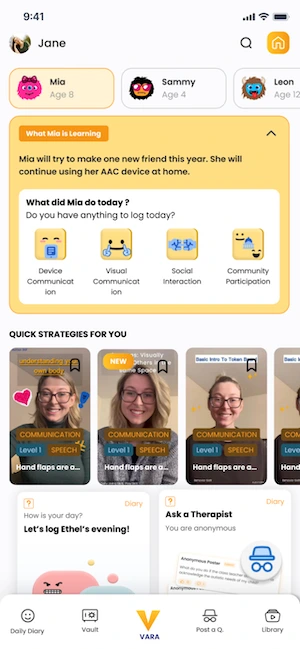
This is where the VARA app from Autism 360 can help. AI-guided Goals helps you pick one developmental goal to focus on, so practice has a clear direction instead of trying everything at once. AI parent coaching gives guidance between appointments on applying a strategy in everyday moments. VARA is a paid app from an independent organisation. It supports you between appointments and alongside your child’s care team.
 AI-guided Goals
What Notes Should You Keep for Your Child’s Clinician?
Write down what you notice, with a real example and when it happened. Raising Children Network gives that advice to parents who have noticed signs of autism, and suggests adding what your child’s educators have seen. Researchers at The Kids Research Institute Australia explain why it matters: clinicians rely on parents to tell them how a child behaves and interacts in different situations.
Useful things to note:
- What your child is good at and loves doing.
- How they communicate, whether by words, gestures, pictures or leading you by the hand.
- How they play and relate to other people.
- Sensory preferences: what they seek out and what they avoid.
- What you tried at home and what happened.
- Any reports from therapists. A guide to getting a diagnosis from the Association for Children with a Disability says the paediatrician will want to see reports and assessments already done.
What about video? Short clips of a parent and child together are a core tool inside programs such as PACT and Inklings, where the therapist and parent review them together. We did not find a source that tells parents to film their child for a diagnostic appointment. Ask your clinic whether clips would help before you start recording.
How Do You Keep Notes Without Making It Another Job?
Keep them short and keep them in one place. Two lines written on the day are more useful than a perfect summary you never get to. Note the date, what happened just before, what you tried and how it went. Over a few weeks, short notes can show patterns that single memories miss, and a pattern gives your clinician something to work with.
VARA’s Daily Diary is built for this: quick daily notes on what you practised, what happened, and the wins and challenges. Short, messy entries are fine. Insight Reports turn your diary entries into patterns and progress over time that you can share with your child’s clinician, school or a new provider. They document patterns; they do not diagnose. A paper notebook does the same job if you prefer one.
Daily DiaryHow Do You Look After Yourself While You Wait?
Treat your own support as part of the plan, because the strain is real and has been measured. A meta-analysis by Hayes and Watson found that parents of autistic children reported more parenting stress than parents of typically developing children, across 10 comparison studies. They also reported more than parents of children with other disabilities, across 12 studies. The authors urged caution on that second result, because it may reflect the specific experience of parenting a child with Down syndrome.
Doing more home practice may not lower that stress by itself. In the Cochrane review, parent-led programs did not change parent stress. In the JASPER trial, the parents who received education did report less. So look for support that is for you, not only for your child.
Raising Children Network suggests small, regular habits: kinder self-talk, about 10 minutes a day of relaxation or mindfulness, keeping routines, doing things you enjoy, asking for help and using respite. The national framework treats family time, rest and ordinary activities as part of support, not as extras. Carer Gateway is on 1800 422 737.
Who Can You Call While You Wait?
You can talk to a person today. You don’t need a diagnosis to call either national line.
- National phoneline: 1800 882 436, 7am to midnight Australian Eastern time, 7 days including public holidays. Answered by maternal and child health nurses. Free, with video call available. It gives general advice about development and behaviour for children aged 8 and under.
- Thriving Kids Autism Helpline: 1300 654 789, Monday to Friday 8am to 7pm, run by Amaze. The official hub says it takes calls about children who are undergoing or waiting for an autism assessment.
- NDIS: 1800 800 110, Monday to Friday 8am to 7pm local time.
- Royal Children’s Hospital Developmental Intake (Melbourne): (03) 9345 4631, for phone advice if your child has been referred there and you are waiting.
- Emergency: 000.
If you would like a clinician to guide you during the wait, Autism 360’s Guided Support offers one-on-one time with a clinician over 12 weeks, alongside the app and workshops. It is a paid support you can start at home now, while Thriving Kids rolls out, and it is separate from Thriving Kids.
What Is a Simple Plan for the Next Two Weeks?
Keep it small: one idea to try at home, and one step that keeps professional help moving. If you can’t decide which idea, go by the hardest part of your day. If it is a routine such as mornings, meals or bedtime, start with a picture schedule. If it is big reactions, start with the plan on the fridge. If it is not knowing what your child wants, start with snack time and waiting.
In two weeks, read back through your notes. Keep what helped, drop what did not, and take the notes to your next appointment.
What we don’t know yet
- Whether home strategies work the same way for children with global developmental delay. We could not find trial evidence specific to that group.
- Whether waiting quietly or adding words to play helps as a strategy used alone. We did not find a trial that tests either one in isolation.
- Whether Inklings, a video feedback program for babies aged 6 to 18 months, is part of Thriving Kids or offered nationally. Its provider’s page mentions access with no out-of-pocket expense for eligible families in WA or SA only, and does not mention Thriving Kids.
- What happened to the babies in the 2021 trial after age 3. We did not confirm any later follow-up.
- Whether filming your child helps at a diagnostic appointment. No source we opened recommends it.
Frequently Asked Questions
How to help a child with developmental delay?
How to help a child with speech delay at home?
Do we need to stop seeking help while we wait for Thriving Kids?
What should I do now?
Does my child need an autism diagnosis?
About this guide: Autism 360 is an independent organisation that provides paid supports for families. We are not a Thriving Kids provider and this is not a government website. This guide is general information, not medical, legal or funding advice. Facts were last checked on 13 October 2026. Always confirm details with the official source.
References
The trusted sources behind this guide
Sources we used
- Australian Government, health.gov.au (Government)National Best Practice Framework for Early Childhood Intervention: A guide for families
- Autism CRC (Guideline)National Guideline for supporting the learning, participation, and wellbeing of autistic children and their families in Australia
- The Kids Research Institute Australia (Article)How you can support your child while you wait for a diagnosis

Ash Bhattacharya is the co-founder and CEO of Autism 360, a global autism brand pioneering parent-mediated intervention. Ash is an autistic adult who grew up in the 1980s with an older autistic brother with high support needs, at a time when there was barely any awareness of autism, let alone acceptance. He saw what his parents faced after his brother’s diagnosis, and how little has changed since for families trying to find support they can afford and access.
That lived experience drives his work. Ash built Autism 360 to put parents in the director’s seat, with the tools, strategies and clinical backing to lead their child’s progress at home. Autism 360 is a registered NDIS provider supporting families across Australia, the USA, Canada and the UK, with outcome-focused programs delivered by speech pathologists, occupational therapists, psychologists and behavior analysts. Ash is a leading advocate for parent empowerment and for making effective autism support affordable and accessible to every family.


