
The best sensory lights for autism are soft, steady or slow-moving lights that your child can control, such as a dimmable lamp, a fiber optic lamp or a bubble tube. The right one depends on whether your child seeks out light or finds it too much, what you want it for (play, a calm corner or bedtime) and their age.
Key takeaways: sensory lights for autism
- The best sensory lights for autism are soft, steady lights your child can control.
- Match the light to whether your child seeks or avoids light.
- Pick cool LED lights with secure batteries and no flashing.
A sensory light (or sensory lamp) is any light chosen for how it feels to look at, rather than just to light a room. For an autistic child who is sensitive to light, that might mean a warm glow that takes the edge off a harsh room. For a child who loves watching lights, it might mean slow color changes or drifting bubbles to settle into. This guide covers the types, how to choose by age and need, the safety checks that matter, and the sensory lights and lamps on Amazon that families tell us they use.

Interactive tool · about 1 minute
Find the Right Sensory Light for Your Child
Answer four quick questions about how your child responds to light and what you need it for. You'll get a short list of light types to try, plus the safety checks that matter for your child.
Question 1 of 4
How does your child usually respond to light?
What Is a Sensory Lamp?
A sensory lamp is a lamp designed to give calming or interesting visual input, usually through soft color, gentle movement or both. Common examples are fiber optic lamps, bubble tubes, lava and liquid motion lamps, jellyfish lamps and star projectors. A plain lamp with a warm, dimmable bulb can also work as a sensory lamp if it helps your child feel comfortable.
“Sensory lights” is the wider term. It also covers LED wall panels, touch lights, light tables, fiber optic curtains and light-up handheld toys. In practice, families use the two terms the same way: a light picked for how it makes your child feel.
Why are People with Autism Sensitive to Light?
Many autistic people process sensory information differently, so a light that seems ordinary to one person can feel glaring, flickering or overwhelming to another. In a study of autistic adults published in Frontiers in Psychology, participants described bright, flickering, fluorescent, strip and spot lighting as uncomfortable, and some said headlights and bright sunshine made getting around harder. The same study noted that some autistic people enjoy visual input such as bright lights and particular color combinations.
That’s the key point for parents: light sensitivity runs in both directions. Some children are over-responsive to light and avoid it. Others are under-responsive and seek it out, staring at fans, lights or spinning objects. Many children do a bit of both, depending on how tired or overloaded they are. Our guide to sensory processing differences explains seeking and avoiding across all the senses.
Speech pathologist and sensory enrichment therapist Stacy Badon, who coaches Autism 360 families, teaches parents that autistic children are often highly aware of visual input. In the Visual System lesson of the Autism 360 Sensory Intervention Strategies course, she explains that long periods of looking can be sensory seeking, a way to manage overload, or real interest, such as tracking patterns. Her advice is to watch what your child looks at and for how long, ask them what they notice (using AAC if they use it), and treat visual interests as possible strengths. As she puts it, “there’s always a reason why from the child’s perspective, sometimes we can figure it out.”
What are the Common Signs of Light Sensitivity in Autism?
 Signs of light sensitivity in autistic adults and children include:
- Discomfort in bright light
- Covering or shielding the eyes
- Blinking a lot or squinting
- Feeling anxious or upset in brightly lit places, such as supermarkets
- Getting headaches from light
These reactions are communication. If your child covers their eyes in the supermarket, the lighting is telling you something. Sunglasses, a cap, dimmer switches and warm-toned globes at home are simple first steps.
Signs your child may be seeking light
Children who seek visual input often:
- Stare at ceiling fans, spinning wheels or flickering screens
- Switch lights on and off over and over
- Hold toys close to their eyes or watch their fingers move
- Light up when they see colorful or moving lights
For these children, a sensory light can give that input in a planned, comfortable way, so they don’t have to hunt for it at less convenient moments.
Do Sensory Lights Help Autistic Children?
Sensory lights can help many autistic children feel calmer, more focused or more comfortable, but they are a support, not a treatment, and they help most when matched to the child. A light that soothes a light-seeking child can overwhelm a child who avoids bright light.
Avia Renouf, a parent coach at Autism 360, made this point in an Autism 360 parent workshop on adaptations and assistive technology. Sensory preferences differ a lot between children, so she suggests watching your child in different spaces and asking a simple question: “Do they need a very bright room or do they really hate it and they want somewhere dark and comfy?” Then trial one change at a time, and ask an occupational therapist for a sensory profile if you want a fuller picture.
In everyday life, families use sensory lights to:
- Make a bright or busy room feel softer
- Give a child something calm to watch while they settle after school
- Create a quiet corner to go to when big feelings build
- Signal that bedtime is coming as part of a wind-down routine
- Turn color and light into play, for example with touch panels or a light table
Types of Sensory Lights and Lamps
Each type of sensory light gives a different kind of visual input, so it helps to know what each one is best for before you buy. Here’s how the main types compare.
Are Sensory Lamps Safe?
Most sensory lamps are safe when you match them to your child’s age and habits and check a few things before you plug them in. These are the checks that matter most.
Heat
LED lights stay cool to touch, which makes them the safest choice for children. Classic glass lava lamps work by heating up, so they get hot. Keep them out of reach, and never let a child touch or move one while it’s on.
Pegs, beads, detachable pieces and small remotes can be choking hazards for children who still mouth objects. Button and coin batteries are especially dangerous. The U.S. Consumer Product Safety Commission warns that a swallowed button battery can burn through a child’s throat or esophagus in as little as two hours. Under Reese’s Law, products with these batteries must have a battery compartment that needs a tool, such as a screwdriver or coin, or two separate movements at once to open. Check that the cover is screwed shut, and keep spare batteries locked away.
Cords and water
Run cords behind furniture or choose battery or rechargeable lights for children who pull, chew or climb. Bubble tubes and bubble walls are filled with water, so they need a stable spot that can’t be tipped over.
Flashing lights and photosensitivity
Skip strobe and fast flash modes for any child who finds them uncomfortable. Flashing light matters even more for children with photosensitive epilepsy. Epilepsy Australia notes that photosensitive epilepsy affects a small number of people with epilepsy (less than 5%), and that seizures most often happen when lights flash 10 to 25 times per second. If your child has seizures, ask their doctor before using any flashing or fast color-changing light, and stick to steady settings.
Sound
Bubble tubes and jellyfish lamps have small motors that can hum, and some lights play music. If your child is sensitive to sound, listen to the light before you commit, or choose a silent LED lamp.
How to Choose a Sensory Light by Age and Need
The right sensory light depends on your child’s age, how they respond to light and what you want the light for. Start with these questions:
- Does your child seek out light, avoid bright light, or both?
- Is it for bedtime, a calm corner, play, or calm on the go?
- Can it be dimmed, and does it have a steady setting?
- Can your child switch it on and off, or control the colors, by themselves?
- Does it flash, hum or play sounds, and can those be turned off?
- Is it cool to touch, with a secure battery cover and no small parts for young children?
If you’re unsure what your child prefers, a remote-controlled light with several modes lets you test different settings. It also helps to know what to avoid at home: fluorescent lights are a common trigger for autistic people with light sensitivity, because of their glare and flicker.
Babies and toddlers (under 3)
Choose lights made for this age, with no small parts, cool-to-touch casing and cords out of reach. A soft, slow-moving light, such as a projector on the ceiling or a sensory fish lamp out of reach, can be a calm part of a nursery routine. Avoid glass lamps and anything a toddler can pull down.
Preschool and early school (3 to 7)
Touch lights, fiber optic lamps, projectors and light tables are popular at this age because children can make something happen. Check the age rating on the box, and keep button batteries locked away.
Older children (8 to 12)
Involve your child in choosing. Ask which colors and effects they like, and agree when each light gets used, for example play lights after school and a dim lamp at night. Light-up fidgets can help some children stay calm and focused in class or on outings.
Teens and adults
Sensory lights for adults and teens tend to look more like room decor: LED wall panels, smart bulbs, a warm desk lamp or a fiber optic lamp. Control matters as much as the light, so let them set it up their own way. Soft, warm light at a desk can also take the edge off bright overhead lighting.
How to try a new sensory light
Introduce one light at a time, at the same time each day, for about a week. Watch your child’s reaction: do they settle, focus, come back to it, or get more excited? If a light seems to wind your child up, try a different setting or a different time of day before giving up on it. Write down what you try and what happens, because a few days of notes will tell you more than a single evening.
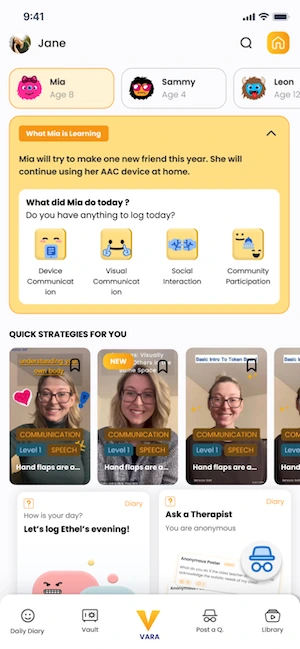
How VARA helps you keep track: a paper notebook works fine for this. If you’d like it all in one place, the Daily Diary in the VARA app gives you quick daily notes on what you practiced, what happened, and the wins and challenges. Short, messy entries are fine, such as “fiber optic lamp after school, settled in 10 minutes” or “projector at bedtime, too exciting.” Over a week or two, those entries show which lights, settings and times of day actually help your child, so you can keep what works and drop what doesn’t.
 Daily Diary
Sensory Lights We Like on Amazon
These seven sensory lights for autism on Amazon cover the main types: Emberela Hexlights, the Bright Autism Calming Sensory Seal Lamp, Bright Autism Tap-Tap Touch Sensory Lights, a sensory fiber optic lamp, a fiber optic curtain kit, Gigilli light-up fidget spinners and the eFiDGET light-up toy. Listings and prices change often, so check the current listing, age rating and reviews before you buy.
1. Emberela Hexlights
Best for: a sensory room centerpiece or wall display for children who enjoy color.
Emberela Hexlights are hexagon-shaped LED panels that can be mounted on a wall or placed on a table using the stand. A remote controls on and off, brightness, colors and effects, or you can tap the panels to change them. If flashing or jumping modes are too much for your child, stick to steady or slow-fade settings. They can make a space feel exciting or relaxing depending on the setting, so they work for both play and calm-down time.
✅Check it out here : Emberela Hexlights
2. Bright Autism Calming Sensory Seal Lamp
Best for: bedtime wind-down for younger children who like gentle sound and movement.
This calming sensory lamp combines soft light effects with gentle sounds and built-in lullabies, which can become part of a soothing bedtime routine. It’s mostly used by kids, but adults with autism can also use it to create a calm space in their room. It can also help as part of a calm-down space when autism anger or overwhelm builds up. If your child is sensitive to sound, try it with the sound off first.
✅Check it out here : Bright Autism Calming Sensory Seal Lamp
3. Bright Autism Tap-Tap Touch Sensory Lights
Best for: interactive play and cause-and-effect for children who like to make things happen.
These touch sensory lights turn a wall into an interactive space: tap or swipe to switch each hexagon on and off. The panels join with internal magnets, so you can build different shapes, and the lighting can be dimmed for wind-down time. Many families use them as sensory wall lights, a play activity or a night light, and colors and shapes can be a fun way to practice naming colors together.
✅Check it out here : Bright Autism Tap-Tap Touch Sensory Lights
4. Sensory Fiber Optic Lamp
Best for: a calm visual focus after a busy day or after a meltdown.
Light travels along the fiber optic strands of this lamp and sparkles at the tips as the colors slowly change, which many children and adults find relaxing to watch. It runs on batteries, so there’s no cord to trip over or pull, and it’s easy to move between rooms. Many children like to hold or stroke the strands, so supervise younger children and check that the strands are firmly attached.
✅Check it out here : Sensory Fiber Optic Lamp
5. Fiber Optic Curtain Sensory Light Kit
Best for: a bigger sensory room or calm corner.
Fiber curtain kits are widely used to make light curtains, art or screens in sensory rooms, and they also work in bedrooms and classrooms. Brightness and speed are adjustable, and you can pick a single static color, which is a good choice for children who find color changes too much. The kit has a sound mode that changes with the rhythm of music; turn it off if your child prefers a steady light. It’s controlled by a remote or an app.
✅Check it out here : Fiber Optic Curtain Sensory Light Kit
6. Gigilli Fidget Spinners
Best for: light-seeking kids who need something small for the car, class or waiting rooms.
Gigilli Fidget Spinners light up as they spin, with a switch to turn the light on or off and several lighting modes. The bearing keeps them quiet when they spin. Many kids with autism enjoy the light-up spinning, and they can help some children relieve stress and stay focused, for example while listening in class. They’re small enough to fit in a bag or pocket, but they’re not suitable for children who still mouth objects.
✅Check it out here : Gigilli Fidget Spinners
7. eFiDGET Light Up Electronic Toy
Best for: older kids, teens and adults who like to stim with lights, sounds and vibration.
This handheld light-up fidget toy has sides that light up and vibrate, combining colorful lights, textures and haptic feedback. You can use it with one hand while reading, talking or waiting, which helps some autistic people stay calm and focused, and it has a silent mode for quieter places. It’s rechargeable, so there’s no button battery to worry about.
✅Check it out here : eFiDGET Light-Up Electronic Toy
More Sensory Lamps for Autism to Consider
If you’re looking for a single sensory lamp rather than a full light setup, these are also popular with families. Check the age rating and safety notes for each one before buying.
Jellyfish lamp
A color-changing aquarium-style lamp with artificial jellyfish that drift slowly through the water. Many children find the movement mesmerizing at wind-down time. The motor that moves the jellyfish can hum a little, so it may not suit children who are sensitive to sound. See the jellyfish lamp
Baby sensory fish lamp
A gentler option for babies and toddlers, with a soft, colorful glow and slow-moving fish. It can be a calm part of a bedtime routine in a nursery or playroom, placed well out of reach. See the baby sensory fish lamp
Lava Squish N’ Flow
A small, squeezable lava lamp toy with slow-moving bubbles. It needs no batteries or power and doesn’t heat up, which makes it a handy calm-down option on the go and a safer alternative to a hot glass lava lamp. It isn’t made to be chewed, so it’s best for older children who no longer mouth objects, with an adult nearby. See Lava Squish N’ Flow
Lite Brite
A light-up peg board that lets children create glowing pictures, with templates and several light modes. It’s a creative, focused activity that many kids enjoy. The pegs are small, so it isn’t suitable for young children or anyone who tends to eat non-food items (pica). See Lite Brite
Acrylic sensory bubble wall
Bubble tubes and bubble walls combine flowing bubbles, color-changing LEDs and a gentle hum. Many come with a remote so you can hold one color or slow the color changes down. Placing one in a corner with mirrors multiplies the effect. They need a dedicated, stable spot and are filled with water, so check the size before you buy. See the Playlearn acrylic sensory bubble wall
How Do You Set Up Sensory Room Lights in a Calm Corner?
You don’t need a dedicated room to use sensory room lights: a corner with a beanbag, a blanket and one or two lights works well. Our guide on how to create a sensory room at home walks through the full setup step by step. For the lighting, many families combine:
- One main soft light, such as a dimmable lamp with warm tones, so the space is never too bright
- One visual focus, such as a fiber optic lamp, bubble tube or LED panels, for watching and settling
- A sensory light projector (stars, waves or clouds on the ceiling) for wind-down time, set to a slow speed
Start with one light, watch how your child responds, and add more only if they enjoy it. Fewer, calmer lights usually work better than lots of competing effects. Keep the corner low-demand, and have it ready before your child needs it, so they can go straight there when the day has been a lot. A calm corner works best as a place your child chooses, never as a punishment.
A sensory space doesn’t need to be expensive. You know how your child reacts, so you can build a space around their preferences, and better still, involve them in choosing. Lights pair well with other sensory tools too, such as the ones in our roundups of sensory toys for autism and sensory chairs for autism.
Choosing a Night Light for an Autistic Child
The best night light for autistic child sleep is usually the simplest: a warm, dim glow that stays the same all night. Harvard Health explains that light of any kind can suppress melatonin, the hormone that helps us feel sleepy, that blue light does so more powerfully, and that dim red lights are a better choice for night lights. So bright, blue-toned or color-changing light can make it harder to fall asleep. When choosing a sensory night light for autistic child bedrooms, look for:
- A warm color (orange or red tones) and a dimmer, so you can keep it as low as possible
- A steady light, or a very slow fade, rather than flashing or fast color changes
- A timer or auto-off, if your child sleeps better once the room is dark
- Controls your child can use, so they can choose when the light is on
- Cool-to-touch casing and secure batteries
Keep the brighter, more colorful sensory lights for kids for play and calm-down time earlier in the day. In an Autism 360 parent workshop on block scheduling, the Autism 360 clinical team suggests giving a child who seeks movement and stimulation their active, stimulating time in a block a couple of hours before dinner, then bringing stimulation down so the hour before bed stays calm, with the same bath and bed steps each night. Lights fit the same pattern. Some families use sensory lights for bedroom wind-down time, such as watching a fiber optic lamp during a bedtime story, then switch to the night light for sleep.
How VARA helps you see the pattern: if bedtime is hard, it can be tricky to see what’s working from one night to the next. Insight Reports in the VARA app turn your diary entries into patterns and progress over time, such as which evening routines and light settings come before an easier night. You can share them with your child’s clinician, school or a new provider. They document patterns; they do not diagnose. Noting what you see in the VARA app makes it easier to spot which lights and routines help your child settle.
Insight ReportsMUST READ :
Best Autism Products on Amazon
Best Autism Sensory Products on Amazon
Frequently Asked Questions About Sensory Lights and Lamps
What is a sensory lamp?
Do sensory lights help autism?
What is the best night light for an autistic child?
Are lava lamps good for autistic children?
Are sensory lights good for adults?
Are sensory lamps safe for young children?
Next Steps: Finding the Light That Works for Your Child
If you’re starting from scratch, start small: one warm, dimmable lamp or one slow-moving light, used at the same time each day for a week. Watch how your child responds, keep a few notes, and only add more once you know what helps. Your child’s reaction is the best guide, and the right light is the one that helps them feel calm, comfortable and in control.
If your child seems very distressed by everyday lighting, gets frequent headaches from light, or has seizures, talk to their doctor or an occupational therapist. They can check for other causes and help you build a sensory plan that covers the whole day, not just the lights.
References
The trusted sources behind this guide
Sources we used
- Frontiers in Psychology (peer-reviewed study)Visual sensory experiences from the viewpoint of autistic adults (Parmar et al., 2021)
- Epilepsy Australia (charity factsheet)Photosensitive epilepsy factsheet (May 2026)
- U.S. Consumer Product Safety Commission (government)Making families safer from button cell or coin battery dangers (Reese's Law)

Stephanie Collins is Head of Program Delivery and a founding member of Autism 360, and the company’s US spokesperson. Based in Colorado, she is a parent of two autistic children, so she brings both professional and lived experience to her work. Stephanie is a behavior support practitioner and developmental educator with more than 15 years in special education, and she is certified in American Sign Language. She is a well-known community advocate for the needs of autistic girls, and has been interviewed on the topic by news channels including Fox, Channel 9 and Channel 5. Stephanie writes about sensory differences, communication, schooling and ADHD.