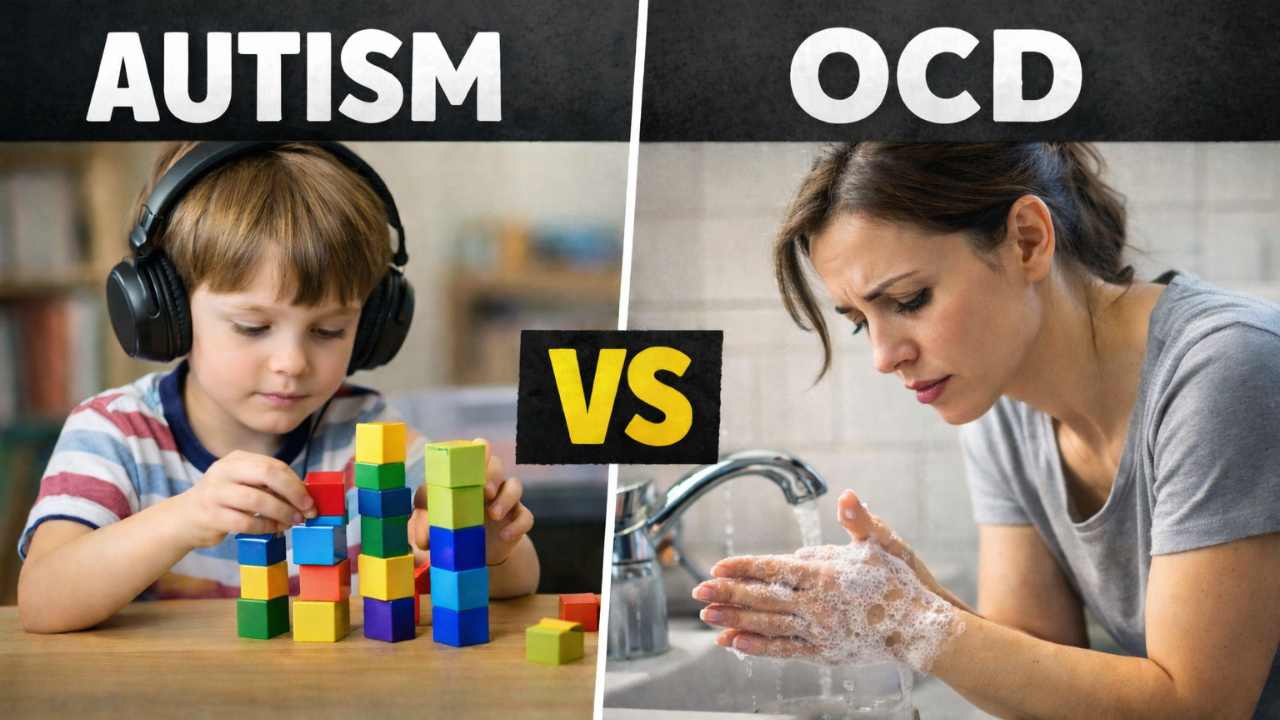
OCD vs autism is a common question for parents, because obsessive-compulsive disorder (OCD) and autism have a close and sometimes confusing relationship. They can look alike from the outside, they are sometimes mistaken for each other, and a person can be both autistic and have OCD. Underneath, though, they are different, and the differences matter for how you support your child.
Key takeaways: OCD vs autism
- Different at the core. OCD vs autism can look alike, but OCD is an anxiety driven mental health condition and autism is a neurodevelopmental difference.
- Ask why. Stimming and compulsions can look alike, but stimming usually feels good or helps regulation, while compulsions are driven by anxious thoughts.
- Passions versus obsessions. A deep interest is usually a source of joy and expertise, while OCD obsessions are unwanted worries that cause anxiety.
- They can overlap. OCD and autism are separate diagnoses, but a person can have both, so get an assessment from someone who understands both.
- Seek assessment. Talk to a pediatrician, psychiatrist or psychologist, and ask for therapy adapted for autistic young people if OCD is diagnosed.
Autism is a neurodevelopmental difference: a different way of experiencing and processing the world that is present from birth. OCD is a mental health condition driven by anxiety. Many parents searching “autism or OCD?” are really asking “why does my child do this, and how do I help?”
Here’s what you need to know about OCD vs autism (or autism vs OCD): what each one looks like, where they overlap, how they differ and how you can support your son or daughter if you notice signs of either or both.
OCD vs Autism
➡ Obsessive-Compulsive Disorder (OCD)
OCD involves obsessions (unwanted, intrusive thoughts, images or urges) and compulsions (repeated actions or mental rituals done to ease the anxiety those thoughts cause). It can affect anyone, regardless of age, sex, gender, race, ethnicity or background. OCD can make daily life, school and relationships very hard, and when an autistic person also has OCD, it can add to the stress they already carry.
A person with OCD usually experiences distressing thoughts that keep coming back. To reduce the anxiety, or to stop something bad from happening, they feel driven to do compulsions. These can be physical actions (like washing or checking) or mental ones (like counting, praying or repeating a phrase in their head). Compulsions take up time and energy and can get in the way of everyday life.
Common obsessions include fears or doubts about safety, unwanted thoughts of a sexual or violent nature, and a strong need for things to be “just right”. Common compulsions include excessive handwashing, repeated cleaning, arranging things over and over, checking, and seeking reassurance from family and friends.
➡ Autism
Autism is a lifelong neurodevelopmental difference that shapes how a person communicates, connects with others and experiences the world. It comes from a mix of genetic and other biological factors.
Common characteristics include:
- Social communication differences, such as a different style of back-and-forth conversation, reading social cues differently, and less or different eye contact
- Communication differences, such as delayed speech, echolalia or scripted speech, being non-speaking, and taking language literally (metaphors, jokes and sarcasm can be confusing)
- Repetitive behaviors and deep interests: intense passions, a strong preference for routine, and stimming such as hand flapping, rocking or hair twirling
- Sensory differences (sensitivity to smells, textures, lights or sounds, or seeking out sensory input)
- Finding transitions and changes in routine hard
OCD and Autism Similarities
On the outside, autism and OCD can look similar in areas like social interaction, intrusive thoughts, repetitive behaviors and intense focus.
Some of the similarities between OCD and autism are:
1. Social interaction differences
Social situations can be hard for people with OCD and for autistic people, for different reasons. Autistic people often communicate and connect differently, and misunderstandings can run both ways. Deep interests can be a great way to make friends who share them, but not everyone will share them. With OCD, anxiety and time spent on rituals can make it hard to join in socially.
2. Intrusive thoughts
Intrusive thoughts are unwanted and often upsetting, and they pop up on their own. They are linked with anxiety, which is common in both autistic people and people with OCD.
Intrusive thoughts are more typical of OCD, but they can happen in autistic people too. Examples include persistent fears of saying or doing something inappropriate, upsetting thoughts about violence, and fears that something bad will happen to themselves or their family.
Ruminating (going over and over the same thoughts) is also common with OCD and anxiety, especially in teenagers.
3. Obsessions and deep interests
People often talk about “obsessions” in both autism and OCD, but they are very different things.
For autistic children, a deep interest or passion is usually a source of joy, comfort and expertise. It can even shape their future, for example, a teenager fascinated by insects may go on to train as an entomologist. Our guide to hyperfixation in autism explains why these passions matter so much.
OCD obsessions are the opposite. They are unwanted worries and fears, such as thinking too much about something harmful happening to family or friends. They cause a lot of anxiety and hold a person back, which isn’t the case with autistic passions.
4. Stimming and compulsions
Stimming is common in autism and includes repetitive movements like rocking, hand flapping and playing with hair.
OCD compulsions can look similar, for example, washing hands again and again or flicking the light switch every time you walk into the house. The real difference is the reason behind your child’s behavior.
For autistic people, stimming usually feels good, helps with regulation or helps manage sensory input and anxiety. It can happen without the person even noticing. People with OCD, on the other hand, usually feel driven to do compulsions because of an anxious thought, and often want to stop. They do them to get rid of discomfort or prevent something bad from happening, which is different from the self-soothing purpose of stimming for autistic teens.
5. Repetitive behaviors and routines
Teens who are autistic, have OCD, or both, may have routines or repetitive behaviors that help relieve anxiety and give them a sense of control. For autistic people, routines usually bring predictability and comfort. For people with OCD, rituals tend to bring only short-term relief before the anxiety returns.
6. Distress and anxiety
Anxiety is common with both. Autistic people may feel anxious because of sensory overload, uncertainty or a world not designed for them. People with OCD feel anxious because of their obsessive thoughts.
OCD and Autism Differences
The main difference between autism and OCD is why your child does a repetitive behavior.
For people with OCD, most compulsions come from anxiety, fear or worry. They often find the behavior distressing and wish they didn’t have to do it.
For autistic teenagers, repetitive actions and deep interests usually come from enjoyment, comfort or regulation. They are part of who the person is, and they generally want to keep doing them.
A simple question that can help: “Does this make my child feel better, or does my child feel they have to do it?” If the behavior brings joy or calm, it is more likely autistic stimming or a deep interest. If it brings fear, distress and a sense of “must”, it may be OCD.
Is OCD Autism?
No. OCD is not autism, and autism is not OCD. They are separate diagnoses with different criteria. However, they can occur together, and some autistic people are diagnosed with OCD as well. Because the outward behaviors can look alike, it’s important to get an assessment from someone who understands both. For more on this question, see our guide to is OCD on the autism spectrum.
OCD vs autism in women and girls
Autistic girls and women are often identified later than boys, partly because many learn to mask their differences. Their routines, deep interests or anxiety may be read as OCD first, or OCD may be missed because worry is put down to autism. A clinician experienced with autistic women and girls can help untangle the two.
OCD vs ADHD vs autism
These three often overlap. Autism is mainly about social communication, sensory differences and a need for predictability. ADHD is mainly about attention, impulsivity and energy. OCD is about anxious, unwanted thoughts and the rituals used to ease them. A child can have one, two or all three, so a full assessment looks at each. Our guide to ADHD vs autism explains how those two differ.
OCD and Autism Diagnosis
A careful diagnosis helps clinicians recommend the right support. Diagnosing autism and OCD involves an in-depth assessment by a qualified professional such as a pediatrician, psychiatrist or psychologist. The process usually includes:
1. Diagnostic criteria
The Diagnostic and Statistical Manual of Mental Disorders (DSM-5) sets out separate criteria for diagnosing autism and OCD. An accurate diagnosis of each is especially important when they occur together.
2. Observations and evaluations
Observing the person in different settings, and using standardized assessments, to understand their traits and support needs.
3. Interviews
The clinician talks with the young person, their parents, teachers and others to learn more about their behavior, traits and early development. Good assessments also give families tailored guidance and help them access the right resources and support.
Co-Occurring Autism with OCD
As well as overlapping in some ways, OCD and autism can co-occur, which means someone can have both at the same time. In fact, 25% of young people with OCD also have autism, as per a report published in the ‘European Child and Adolescent Psychiatry‘ journal.
Because the two can look similar, one can be mistaken for the other. This can lead to support that doesn’t fit and extra frustration for the young person and their family.
Standardized screening tools for autism and OCD can support an accurate diagnosis.
📌 MUST READ : Autism & Co-Existing Conditions
Suspect Your Child Has Autism, OCD, or Both? What Next?
Both autism and OCD are fairly common, but they’re often misunderstood or mistaken for each other because they share some similarities. Knowing what makes each one different helps you get the right diagnosis, find the right support and connect with people who understand.
1. Seeking a diagnosis
Look for a qualified professional with experience in assessing both autism and OCD. In Australia, your GP can refer you to a pediatrician, psychiatrist or psychologist.
A thorough assessment by an experienced clinician can help you understand your child’s profile and access the right support. Before that appointment, our free online autism test can help you put what you have noticed in order.
Try to find someone who understands how autism and OCD can present differently in children, teens, girls and women, people who are non-binary or gender diverse, and people from culturally diverse backgrounds. Much of the early research behind diagnostic guidelines was based mainly on white boys and men, so some people are missed.
2. Therapy options
Therapy can help with both autism and OCD, but the approach depends on what your child needs most. Options include:
For OCD, the main evidence-based therapy is CBT with exposure and response prevention (ERP), where a therapist helps the person gradually face their fears without doing the compulsion. For autistic young people with OCD, it works best when it is adapted: more visual supports, clear and literal language, involving parents and making sure therapy targets OCD compulsions, not autistic stimming or routines that bring comfort.
For autism, support focuses on communication (including AAC), sensory needs, wellbeing and building on strengths, rather than changing who the person is.
3. Medication
Medication doesn’t change autism, but it can help with OCD. A class of medicines called SSRIs is commonly prescribed for OCD, usually alongside therapy. Any decision about medication should be made with your child’s doctor, who can explain the benefits, side effects and how to monitor them.
4. Community and support
Connecting with others who have lived experience of autism or OCD can give you helpful resources, a non-judgmental space to learn and guidance from people in a similar situation.
Joining a dedicated Facebook group, watching informative YouTube videos and following autistic people and people with OCD or autism on TikTok, X (Twitter) or Instagram can be great ways to get support and learn more. Not everything online is accurate, though, and misinformation spreads quickly. Look for trusted accounts and get guidance from qualified health professionals who are experienced with both OCD and autism.
Strategies for Supporting OCD and Autism at Home
Along with therapy, these strategies can reduce stress and help your child feel safer and more in control:
- Keep a predictable routine to reduce stress and anxiety and give a sense of security
- Use visual supports such as schedules, social stories and charts to make transitions and expectations clear
- Teach calming strategies that suit your child (deep breathing, movement, mindfulness or time with a favorite interest) to ease anxiety
- Create sensory-friendly spaces and offer sensory tools (fidget toys or noise-canceling headphones) to help with sensory needs
- Notice the “why” behind a behavior before you try to change it. Leave autistic stimming and comforting routines alone, and get help for compulsions that cause distress
- With OCD, try not to join in rituals or give endless reassurance, as this can feed the anxiety. A therapist can help you step back gently
- Name the OCD as separate from your child (“That’s the OCD worry talking”), so they don’t feel blamed
📌 MUST READ :
Autism and OCD : What is the Difference?
Differences Between Aspergers and Autism
How are Auditory Processing Disorder and Autism Connected?
Conclusion
Autism and OCD can both involve repetitive behaviors and routines, but they are different, with different signs, diagnostic criteria and support needs. When it comes to obsessive compulsive disorder vs autism, the key question is whether a behavior brings comfort or causes distress. Understanding how they overlap and where they differ helps you see what your child is experiencing, find the right support and stand beside them as they navigate both worlds.

Stephanie Collins is Head of Program Delivery and a founding member of Autism 360, and the company’s US spokesperson. Based in Colorado, she is a parent of two autistic children, so she brings both professional and lived experience to her work. Stephanie is a behavior support practitioner and developmental educator with more than 15 years in special education, and she is certified in American Sign Language. She is a well-known community advocate for the needs of autistic girls, and has been interviewed on the topic by news channels including Fox, Channel 9 and Channel 5. Stephanie writes about sensory differences, communication, schooling and ADHD.