


Hyperlexia is a learning difference where a child reads words much earlier than expected, well ahead of how much they understand or say. Cleveland Clinic reports that approximately 84% of children who have hyperlexia are on the autism spectrum.
Key takeaways: hyperlexia
- Reading ahead. Hyperlexia means a child reads far earlier than expected, well ahead of understanding and talking.
- Link to autism. It often goes with autism, but early reading alone does not mean a child is autistic.
- Build meaning. Labels, written answers and letter play can turn a love of words into communication.
- Get checked. Book a pediatrician visit if your child reads but does not ask for things with words, signs or pictures.
Picture a 3 year old who reads EXIT signs and cereal boxes out loud, but does not answer when you ask what they want for lunch. You feel proud and puzzled at the same time, and both feelings make sense.
This guide covers the signs, what the research says, the three proposed types, and practical ways to use your child’s love of words to build communication.

Interactive tool · about 2 minutes
Reading Strengths Planner: Where to Start
Tell us what you notice about your child and letters, and where you want reading to help first. You'll get a short list of ideas to try at home this week.
Question 1 of 3
What have you noticed about your child and letters?
Pick all that fit. This is for planning, not a test.
What are the signs of hyperlexia?
The main sign is reading that runs far ahead of understanding and talking. Cleveland Clinic lists these common signs:
- Learning to read quickly with little instruction, sometimes teaching themselves
- Choosing books and reading materials over other toys
- An intense interest in letters and numbers
- Reduced comprehension, such as trouble understanding how to play a game or do a puzzle
- Possible communication and speech delays
Speech pathologist Stacy Badon teaches this in the Autism 360 course Communication Skills Intermediate. She says, “I often hear from parents that their child is reading but not using their words to communicate.” In her clinical experience, early reading can appear around ages 1 and 2, without anyone teaching it.
Early reading alone does not mean your child has hyperlexia or is autistic. Many children read early and also understand and chat happily. The pattern that matters is reading that outpaces comprehension and communication.
Is hyperlexia a sign of autism?
Hyperlexia and autism often go together, but they are not the same thing. Cleveland Clinic says only 6% to 14% of children who are autistic also have hyperlexia. A 2024 study in Molecular Autism by Ostrolenk and colleagues puts it higher, at up to 20% of autistic individuals, with the range of 6% to 20% depending on the criteria used.
The same study looked at interest in letters and numbers in two groups of Quebec children. Between 22% and 37% of autistic children had an intense or exclusive interest in letters. Compared with non-autistic children seen at the same clinic at the same age, the odds of a greater interest in letters were 2.78 times higher, and in numbers 3.49 times higher.
These interests appeared at a median age of 30 months. They showed up whether or not a child could talk yet, and in one study 76% of the autistic children were minimally verbal or non-speaking. The children mostly enjoyed letters on their own rather than sharing them with others.
The authors suggest language learning in autism may follow an alternative pathway. They also note that how best to use letter interests in support is not yet established.
So this is neither a reason to panic nor something to ignore. A child who loves letters is showing you a strength and a way of learning. It is also a good moment to look at communication more closely.
What causes hyperlexia?
Nobody knows the exact cause of hyperlexia. Cleveland Clinic says it is thought to come from a mix of genetic and environmental factors that affect how the brain develops, and there is no known way to prevent it. What parents can shape is how that early reading gets used, which is what the rest of this guide is about.
What are the three types of hyperlexia?
Cleveland Clinic describes three types, and they differ mainly in how reading links with language and autism.
Type 3 is the most debated. Psychiatrist Darold Treffert proposed it, describing superior reading with some autism-like signs that generally fade over time. He wrote that these children may be outgoing and interactive, especially with adults.
His view rests on more than 200 reports from parents. That is valuable experience, but it is anecdotal, not a controlled study. He urged clinicians to be careful about diagnosing autism at a very early age. Treat type 3 as a proposed category that is still discussed, not settled science.
Why can a child read words but not understand them?
Decoding and comprehension are two separate skills. Decoding means turning printed letters into sounds and words. Comprehension means knowing what those words mean and how they connect.
A child can read “The dog sat on the mat” perfectly and still not picture a dog, or answer “Where did the dog sit?” It is like reading a recipe in a language you do not speak. You can say every word, but you cannot cook the meal.
This is why pictures matter. Stacy Badon, in her Modelling lesson, points to comic books for children aged 6 and up. She explains, “Comic books are a really good way for kids to connect words to visuals because the connections right there.”
The word sits right beside the picture, so meaning is built into the page. Many children who read early also repeat phrases they have heard, which links to gestalt language processing.

How can you use your child’s reading to build communication?
Your child’s reading is a bridge you can cross together. The six strategies below use written words to support understanding and talking.
How do you help when spoken words do not land?
Write the answer down. The Autism 360 clinical team shares this from its parent workshop “Stimming, Skipping and Flapping with Joy”. When a child asks the same question again and again, it is often because spoken words disappear and the answer cannot be rechecked. As the team puts it, “When we answer verbally, they get it, but it’s not there.”
Here is what to do:
- Write the answer on paper, type it or draw a picture
- Post it where your child can see it
- Point to it when the question comes again
- Add visuals showing what is happening next
For a child who reads well, a written answer is something they can go back and check on their own, without needing to ask again.
How can you label your home and routines with written words?
Labels turn the words your child already loves into daily communication. Put a word card on the snack cupboard, the shoe basket and the bathroom door. Offer two written choices at snack time, such as “crackers” and “apple”, and let your child point to one.
A written schedule for the morning or after school works the same way. It supports clear, predictable communication, because your child can reread the plan whenever they need it. You can find free printable visual supports to start with.
If you want to go deeper on building everyday communication, the Communication Skills Advanced masterclass is a helpful next step.
How do you build understanding, not just reading?
Connect each word to something your child can see, touch or do. Stacy Badon suggests building vocabulary through the books and words your child already loves.
- Leave interesting books out and read aloud, even if your child is moving around the room
- Replay phone videos of your child and describe what they are doing
- Offer comic books from age 6, where words sit beside the picture
- Play family board games to meet less common words
Try simple who, what and where questions with a picture to point to. Act out a sentence together, such as “jump to the door”. Skip flashcards: real moments teach meaning better than drills.
If your child also has delayed talking, read more about autism and speech delay. Understanding how autistic children learn best can also guide what you try first.
How can letter love become play and movement?
Mix letters with sensory input so your child learns through the body as well as the eyes. In an Autism 360 workshop on decoding sensory needs at home, Stacy Badon shares simple ideas:
- Tape lines on the floor with letters along them, so your child walks, picks one up and says the letter
- Fill a tray with salt or finger paint to practice letters, numbers or names
- Hide letters in a bin of rice, pasta or beans
She keeps it low cost: “I’m very much all about not having to buy a bunch of fancy things.”
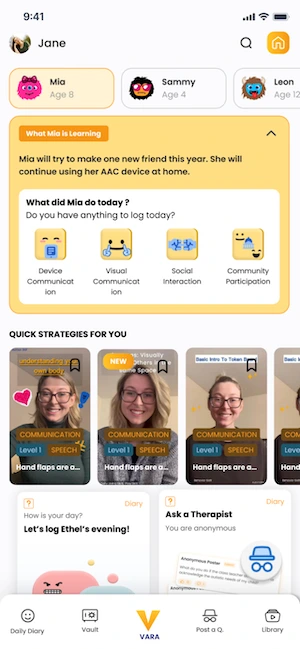
Once play is working, pick one small goal rather than ten, so your child and you both know what success looks like this week. For example, your child uses a written word card to ask for a snack. VARA’s AI-guided Goals helps you pick one developmental goal to focus on, so practice has a clear direction instead of trying everything at once.
Then AI parent coaching gives you guidance between appointments on applying a strategy in everyday moments, so you feel confident you are doing it right. VARA is a support tool for parents, used between appointments and alongside your child’s care team, never a replacement for therapy.
 AI-guided Goals
What can you do when reading everything slows an outing?
Plan ahead so signs and labels do not block each transition. Stacy Badon recommends preparing supports for outings, because a child who reads every sign may stop at each one.
Tell your child the plan before you leave and show it in writing: “car, shop, home”. Let them read one sign on the way in and one on the way out. Naming a clear end to each reading stop keeps the day moving without taking away something they love.
What should you write down before an evaluation?
Keep a record of what you notice, because clear notes make appointments more useful. Write down what your child reads, what they say, what they seem to understand, and the date. A notebook works fine for this, and plenty of families never need more. Whatever you choose, keep it somewhere easy to reach so notes get written while the moment is fresh.
If you want more structure, VARA offers Early Signs Documentation: a structured way to document the early signs you are noticing, so you arrive at an assessment with records instead of vague memories. Its Daily Diary gives you quick daily notes on what you practiced, what happened, and the wins and challenges. Short, messy entries are fine.
Insight Reports turn your diary entries into patterns and progress over time that you can share with your child’s clinician, school or a new provider. They document patterns; they do not diagnose.
 Daily Diary
When should you get your child evaluated?
Start with your pediatrician if you are worried about your child’s communication, whatever their reading skills. Cleveland Clinic notes the pediatrician is the first point of contact and may refer you to a child psychologist or speech-language pathologist. Stacy Badon advises a speech therapist evaluation if you suspect hyperlexia.
There is no specific test for hyperlexia, and the DSM-5 has no clear definition of it. It is not a diagnosis on its own. If autism is a question, it helps to know how autism is diagnosed so you know what to expect.
Book an appointment soon if your child:
- Reads but does not use words, signs or pictures to ask for things
- Does not respond to their name
- Loses words or skills they once had
- Becomes very distressed when reading is interrupted and cannot be comforted
Cleveland Clinic says types 2 and 3 may benefit from speech therapy, occupational therapy and psychological support. An early evaluation helps you find the right match.
Your first two weeks: a simple starter plan
You do not need to do everything at once. Use this plan to start small and see what works for your child.
- Days 1 to 3: Write down what your child reads, says and understands, with dates.
- Days 4 to 5: Make three word cards for things your child asks for often, and place them where your child can reach them.
- Days 6 to 8: Write down the answer to your child’s most repeated question and post it at eye level.
- Days 9 to 10: Try one letter play activity, such as a salt tray or taped floor letters.
- Days 11 to 12: Read one favorite book aloud and point to the pictures as you name them.
- Days 13 to 14: Review your notes. If speech or understanding has not moved, book a pediatrician visit and bring them.
If anything on the “book soon” list above is happening, do not wait for the two weeks to finish. Make the appointment now.
FAQs About Hyperlexia
What is hyperlexia in simple terms?
Is hyperlexia a sign of autism?
Is hyperlexia a sign of giftedness?
Is hyperlexia bad?
What is hyperlexia 3?
What is the difference between hyperlexia and dyslexia?
References
The trusted sources behind this guide
Sources we used
- Cleveland Clinic (health guide)Hyperlexia: Signs, Diagnosis and Treatment
- Molecular Autism (peer-reviewed study)Enhanced interest in letters and numbers in autistic children (2024)
- The Transmitter (expert article)When a flair for reading is mistaken for autism (Treffert, 2016)

Rachael Young is a behavior analyst with Autism 360, specializing in tailored, evidence-based support that improves daily life for children and their families. She is an Adjunct Instructor at Arizona State University, where she trains the next generation of behavior analysts, and is completing a PsyD in Clinical Psychology to deepen her clinical practice. Rachael is proud to identify as neurodivergent, and that lived perspective shapes the empathy and practicality of her work. She writes about ABA, autism in girls and women, co-occurring conditions and the teen years.


