
Gestalt language processing is a way of learning language in whole chunks, such as a line from a favorite movie, before breaking those chunks into single words. Many autistic children learn to talk this way, and the chunks are often called scripts or delayed echolalia.
Key takeaways: gestalt language processing
- Learning in chunks. Gestalt language processing means learning language in whole chunks, like movie lines, before breaking them into single words.
- Scripts are messages. Treat echoes and scripts as communication by asking what your child was doing, feeling or wanting.
- Not a diagnosis. It is a descriptive label, and the six stages come from clinical observation, not tested research.
- Get extra help. Talk to a speech language pathologist if speech is mostly echoed after age 3 or your child loses words or skills.
Maybe your child shouts “To infinity and beyond!” every time they jump off the couch. Or they say “Do you want a cookie?” when they mean “I want a cookie.” That is not random. This guide explains what the label means, what the research does and does not show, and what you can do at home this week.

Interactive tool · about 2 minutes
Decode Your Child's Scripts: What to Try First
Pick what your child's scripts sound like and when they show up. You'll get a short, practical list of what to try at home this week.
Question 1 of 3
What do your child's scripts and echoes usually sound like?
Pick all that fit.
What is gestalt language processing?
Gestalt language processing means a child learns language in whole chunks, called gestalts, and works out the smaller parts later. An analytic language learner usually starts with single words, like “ball” or “more”, and joins them into short phrases.
Speech-language researcher Barry Prizant described a “gestalt” style of language learning in autistic children in 1983, building on earlier work by linguist Ann Peters. Since then, the idea has spread through speech therapy offices and parent groups.
Gestalt language processing is a descriptive label, not a diagnosis. According to Cleveland Clinic, there is no formal test for it, and experts disagree about exactly how to define it.
It is also not an either-or choice. All children use some chunks, like “thank you” or “I don’t know”. Think of a spectrum, not two boxes. The cards below show how the two styles often differ.
What does gestalt language look like at home?
Gestalt language usually sounds like ready-made phrases used for a purpose, often with the exact tune of the original. It overlaps with immediate and delayed echolalia, though not every echo is a gestalt. Parents often describe things like these:
- A line from a movie or show, such as “To infinity and beyond!” said while jumping off the couch.
- A whole phrase in your own voice and intonation, repeated back hours or days later.
- A phrase that stands for a situation, like “Let’s get you in the car” meaning “I want to go out”.
- Pronoun mix-ups, like “You want juice” meaning “I want juice”.
- A jingle or song sung in the middle of a routine.
- Parts of two scripts mixed into one new phrase.
Speech pathologist Stacy Badon, who coaches Autism 360 families, teaches in the course “Foundations of Social and Communication Skills” that echolalia is purposeful. A delayed echo shows your child processed the language. An immediate echo can help confirm what was asked.
In her words, “It’s like a cheat sheet for communication.” A script gives your child a ready-made way to say something complex, like “I’m done”. Some children who script also read words very early, a pattern explained in our guide to hyperlexia in autistic children.
Her advice is to listen and watch until you learn your child’s scripting code. If your child echoes “Do you want a cookie?”, model the phrase you want to hear, like “want cookie”, and hand over the cookie right away. You are treating the script as communication while gently shaping phrases that more listeners will understand.
What are the stages of gestalt language processing?
Marge Blanc’s Natural Language Acquisition (NLA) framework, described in her 2012 book, lays out six stages. In plain words, they are:
- Whole gestalts: long chunks used as one unit.
- Mitigations: chunks are broken up and mixed together.
- Single words and two-word combinations.
- Original phrases and beginning sentences.
- Original sentences with more complex grammar.
- Original sentences using full grammar.
These stages come from clinical observation. They have not been tested in peer-reviewed research, according to a 2024 review from the Association for Science in Autism Treatment and a 2024 critical analysis by Hutchins and colleagues.
So treat the stages as one clinician’s map, not a checklist your child must follow.
Is gestalt language processing a sign of autism?
No. Gestalt language processing is not a diagnostic sign, and it is not limited to autistic children. Echolalia is common in autistic children, and it is also part of typical development. You can read more about how echolalia and autism connect.
Cleveland Clinic notes that echolalia is normal while a child is learning to talk and usually fades by about age 3. Raise it with your pediatrician or a speech-language pathologist if speech is still mostly echoed after age 3, or if your child loses words or skills they had before.
Chunky speech alongside few new words can also be part of autism and speech delay. Look at the whole picture, not one sign.
What does the research on gestalt language processing actually say?
Your child’s scripts are real communication. What is unproven is the specific stage-by-stage method.
A 2025 systematic review by Bryant and colleagues in Current Developmental Disorders Reports searched 18 scientific databases and 3 clinical trial registries. It found no empirical research evaluating the effectiveness of GLP/NLA-based approaches, only commentaries, editorials and books. The authors say clinicians have an ethical responsibility to tell parents about this lack of research.
Hutchins, Knox and Fletcher (2024) concluded that the theory behind NLA lacks empirical support and that its stages are implausible. They write that “all language-developing children rely on chunky parsing to process language”. They also criticized NLA advice to avoid verbs at stage 3.
Lorang and colleagues (2025), in Perspectives of the ASHA Special Interest Groups, note that eye-tracking studies show autistic children process speech word by word. Removing verbs from adult speech may work against evidence that verb input helps language.
ASHA’s Practice Portal adds that echolalia was historically described as meaningless, but research now shows it can serve purposes like turn-taking, labeling, requesting, affirming and protesting.
None of this means the clinicians who use NLA are doing something wrong. It also does not mean your observations are mistaken. It means the evidence has not caught up with the enthusiasm.
What is good practice either way?
Even the critics name common ground with NLA supporters. Lorang and colleagues list several habits that remain good practice, and they make a good place to start:
- Treat echoes and scripts as communication.
- Follow your child’s lead.
- Keep modeling language, including verbs.
- Accept every way your child answers, including AAC.
- Work as one team with your child’s family and therapists.
Questions to ask before starting an NLA-based program
You are allowed to ask for details before you commit. These questions keep the conversation friendly and specific:
- What evidence supports this approach for my child?
- How will you measure progress, and how will you tell me?
- Will my child keep using AAC while we work on spoken language?
- Will you still model verbs and full sentences, or hold them back?
- How long before we sit down and review whether it is working?
How can you support a gestalt language processor at home?
You can support a gestalt language processor with a notebook and a few small habits: notice scripts, write them down, model useful language and keep the door open. These habits fit well with clear, predictable communication at home.
Treat every script as a message
Start by asking what your child was doing, feeling or wanting when the script appeared. Note when it happened, where, and what happened next. If your child says “Let’s get you in the car” at the front door, the message may be “I want to go out”.
The Autism 360 coaches panel on social development, with Dr. Jennifer Welker, Ella Bailey and Kim Alexander, talked about scripting as a valid way to use language. As one coach on the panel put it, “scripting isn’t inherently bad.” Scripting can be an escape or a self-soothing tool. Under social pressure and anxiety, children may not be able to reach skills they already know.
Their practical tips: bring visual conversation cues to social settings, and role-play social situations at home first. Build skills around interactions your child is motivated by, even a Minecraft chat.
Keep a script dictionary
A script dictionary is a notebook page with four columns: the script, the situation, what you think it means, and how you responded. Write down a script as soon as you can, even in rough shorthand.
After two weeks, patterns often show up. The same line may appear before meals, or only when the room gets loud. Those patterns tell you what your child is trying to say.
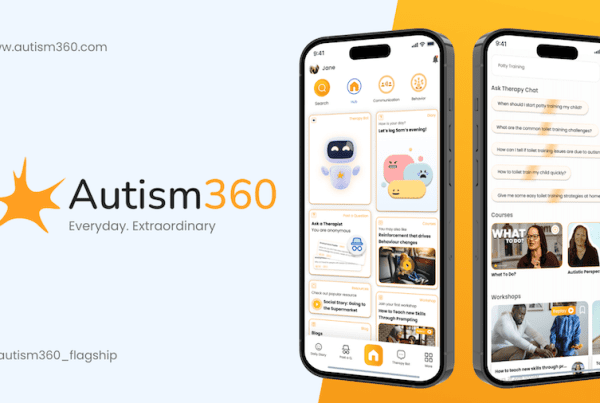
A paper notebook works well. If you would rather keep it on your phone, the VARA app is a clinically informed support tool that helps families practice and track their child’s development at home, between appointments and alongside their child’s care team. Daily Diary gives you quick daily notes on what you practiced, what happened, and the wins and challenges. Short, messy entries are fine, so “car script at the door, wanted to go out” is plenty.
Insight Reports turn your diary entries into patterns and progress over time that you can share with your child’s clinician, school or a new provider. They document patterns; they do not diagnose.
 Daily Diary
Model language from your child’s point of view
Say the words your child would use about themselves. Michelle Dannels, speaking at an Autism 360 parent workshop on Hanen strategies, put it this way: “Echolalia serves a communicative function and it definitely has meaning to the child.”
Many autistic children repeat what they hear. If you say “you want bubbles”, your child may later use “you” to mean themselves. Say “bubbles” or “I want bubbles” instead.
Model just one step above your child’s current level. If they use single words, try two. Add small functional words like here, there, in, on and now. And accept every attempt to communicate, including points and looks.
Model short, useful phrases your child can borrow
Pick a few short phrases that work in many situations, like “let’s go”, “all done” and “I need help”. Say them with clear intonation during play and routines, always in the same kind of moment.
Many autistic children learn best when the same words meet the same situation again and again. You can read more about how autistic children learn.
When your child echoes one of these phrases back, accept it as an answer. So is a sign, a picture or a tap on an AAC device. Keep your own talking natural, with verbs and full sentences, too.
Keep talking even when your child seems not to be listening
Your child is probably taking in more than you can see. Ash Bhattacharya, co-founder of Autism 360, and Stacy Badon cover this in Communication Masterclass Episode 2: 7 Communication Strategies, part of the Let’s Communicate Program. Their message: “Children are picking up on every single thing that you say they are hearing every single thing that you say.”
Children absorb words modeled around them even when they stay silent. Then, in a spontaneous and motivating moment, they may suddenly use one.
So include your child in family gatherings and parallel play. Keep modeling words during play, even if you get nothing back. Never talk as if your child is not in the room. And be mindful of what you say, because words may be echoed later.
One focus is easier to keep up than ten. A good example: model “all done” at the end of every meal for two weeks. In VARA, AI-guided Goals helps you pick one developmental goal to focus on, so practice has a clear direction instead of trying everything at once. AI parent coaching gives you guidance between appointments on applying a strategy in everyday moments, so you feel confident you are doing it right.
AI-guided GoalsMake space for scripting
Scripting can be calming, so there is no need to ban it. Build in alone time to script before or after social demands, the same way you might build in a snack or a quiet break.
Also watch for the moments when scripting goes up. It can flag a situation that is causing stress, such as a loud room or a change in plans. That is useful information, not misbehavior.

Pick one of these habits to start with, rather than trying them all at once.
When should you talk to a speech-language pathologist?
Talk to a speech-language pathologist (SLP) when you want a professional view of how your child communicates, and sooner if you notice any of these signs:
- No new words for several months.
- Frustration when people do not understand your child.
- Loss of words or skills your child used before.
- Speech that is still mostly echoed after age 3.
- You want help decoding scripts and planning what to model.
A neurodiversity-affirming SLP can assess your child, explain what they see and plan with you. Our guide to speech therapy for autistic children explains what sessions can look like.
If spoken words are slow to come, AAC devices can give your child a way to communicate right now.
If you want to learn the skills yourself, we recommend Stacy Badon’s Communication Skills Advanced masterclass, which covers gestalt language and how to build on it at home.
What to do this week
- Pick three scripts you hear most often and note when they happen.
- Start your script dictionary tonight, with those three scripts as the first entries.
- Choose three short phrases to model, like “let’s go”, “all done” and “I need help”.
- Ask your SLP the questions above, or book a visit to talk them through.
At the end of the week, look at your notebook and find the script that showed up most. What it seemed to mean is your starting point for next week.
Frequently Asked Questions about Gestalt Language Processing
How do I know if my child is a gestalt language processor?
Is gestalt language processing a sign of autism?
What is an example of a gestalt?
Is gestalt language processing evidence-based?
Can gestalt language processors use AAC?
References
The trusted sources behind this guide
Sources we used
- Current Developmental Disorders Reports (peer-reviewed study)Bryant et al. (2025): Systematic review of GLP/NLA interventions
- Autism & Developmental Language Impairments (peer-reviewed study)Hutchins, Knox and Fletcher (2024): A critical analysis of NLA and GLP
- Association for Science in Autism Treatment (research review)Natural Language Acquisition: what the science says

Stephanie Collins is Head of Program Delivery and a founding member of Autism 360, and the company’s US spokesperson. Based in Colorado, she is a parent of two autistic children, so she brings both professional and lived experience to her work. Stephanie is a behavior support practitioner and developmental educator with more than 15 years in special education, and she is certified in American Sign Language. She is a well-known community advocate for the needs of autistic girls, and has been interviewed on the topic by news channels including Fox, Channel 9 and Channel 5. Stephanie writes about sensory differences, communication, schooling and ADHD.