


This story was first published in 2016.
This is the story of how one autism mom began making dolls with disabilities, so that disabled and autistic children could see themselves in their toys.
Most four-year-olds spend their days singing, dancing, blowing kisses and playing.
That is not the situation for Kate Grant, whose four-year-old daughter Millie was diagnosed with leukemia at the age of three.
Kate believes the usual “princess” dolls from the shops don’t suit Millie. Millie finds it hard to connect with these dolls, and they can leave her feeling low. Kate says,
My little darling is out there in the hospital with a shaved head. She realizes that she is different. I would feel terribly guilty bringing her a popular Barbie with beautiful long hair.
So when a family friend visited Millie in hospital, she brought along a welcome surprise: a personalized doll!
Dolls With Disabilities: How One Mom Started Making Them

Maria believes that Dolls with Disabilities will give kids with disabilities something to look forward to!
Maria Kentley, who specializes in customized dolls, was the person behind this bright idea. Ms Kentley gets many requests every day. For instance, one parent asked for a doll with a wheelchair and a scar, because her daughter has spina bifida.
“A different request may come up from another parent,” she says.
Maria Kentley has two children, both of whom are autistic, and says her sons inspired her to launch this service for other parents.
Maria highlights the importance of building confidence in children with special needs. As a mom, she encourages her sons to see autism, or being “autistic”, as something that sets them apart and that they can be proud of.
Ms Kentley has also designed dolls with tags such as
I am autistic yet awesome
with the aim of helping children feel good about who they are.
Lauren Wertheimer, a clinical psychologist, is confident that dolls like these give children something to cherish and can help build acceptance in the wider community.
Ms Kentley makes each doll with great care, taking up to 15 hours to ensure quality. Most dolls are priced at around $35, which covers the cost of materials and labor.
According to Maria,
the cost of the dolls is immaterial when compared with the happiness it brings to young children. Their happiness is priceless!
Ms Kentley adds that she loves receiving feedback from parents, who are delighted to see their little ones cherishing her dolls.
Why Dolls With Disabilities Matter for Autistic and Disabled Children
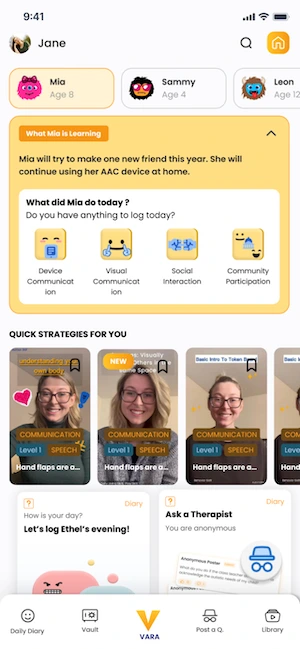
Children notice when they never see themselves in books, shows or toys. A doll with a wheelchair, hearing aids, ear defenders or an AAC device can help a disabled or autistic child feel seen, and it gives non-disabled children a natural way to learn that bodies and brains come in many forms. If you can’t find one, you can adapt a favorite toy together, for example by adding a pair of headphones or a communication board, and let your child lead the play. Our guide to autism toys has more ideas that follow your child’s interests, and our autism parenting app, VARA by Autism360, lets you ask an autism therapist how to build on the play your child already loves.
Is there an autism doll or autistic Barbie?
Yes. Since this story was written, mainstream toy makers have followed small makers like Maria. In 2025 Mattel added an autistic Barbie to its Fashionistas range, with noise-canceling headphones, a fidget spinner and a tablet showing an AAC app. Handmade and personalized dolls are still a great option if you want a doll that looks like your own child. Our list of 30 autism gift ideas, sorted by age, has more options. For more play ideas, see our guide to sensory toys for autism.

Ash Bhattacharya is the co-founder and CEO of Autism 360, a global autism brand pioneering parent-mediated intervention. Ash is an autistic adult who grew up in the 1980s with an older autistic brother with high support needs, at a time when there was barely any awareness of autism, let alone acceptance. He saw what his parents faced after his brother’s diagnosis, and how little has changed since for families trying to find support they can afford and access.
That lived experience drives his work. Ash built Autism 360 to put parents in the director’s seat, with the tools, strategies and clinical backing to lead their child’s progress at home. Autism 360 is a registered NDIS provider supporting families across Australia, the USA, Canada and the UK, with outcome-focused programs delivered by speech pathologists, occupational therapists, psychologists and behavior analysts. Ash is a leading advocate for parent empowerment and for making effective autism support affordable and accessible to every family.


