Communication Cards: Food is a free set of food communication cards: simple visuals of different foods that your child can use to tell you what they want to eat, and that you can use when teaching food names. Food visuals for autism support work well for children who are non-speaking, minimally speaking, or who find words harder to reach when they’re hungry, tired or overwhelmed.
What Are Communication Cards: Food?
Communication Cards: Food contains visuals (communication cards) of different foods. Your child can use them to communicate, for example to answer “What do you want for breakfast?”, and you can use them when teaching the names of foods.
You can use these visuals in a task analysis (a step-by-step breakdown of a routine), on a visual schedule, on a choice board, or in any other strategy that involves food.
Learning about different foods helps your child tell you what they want to eat and see what is available to them. Being able to make a choice and have it understood gives children more control over their day, which can mean less frustration at mealtimes. A food preferences worksheet can help you decide which foods to add first.

How to Use Food Communication Cards With Your Child
- Start with favorites. Print and cut out two or three foods your child already loves. A choice your child really wants is the best motivation to use a card. Many families start with their child’s safe foods, the foods they reliably accept.
- Offer a choice of two. Hold up two eat visual cards, say the names (“apple or crackers?”) and give your child the food they point to, touch or hand you. Every way of choosing counts.
- Pair the card with the real food. Show the card and the actual food together so your child links the picture to the item.
- Keep them where food happens. Stick a few cards on the fridge or pantry door, or make a small choice board for the kitchen table.
- Add slowly. Once your child uses the first cards confidently, add new foods one or two at a time, including “finished”, “more” or “help” if you have them.
- Use them on the go. A small set on a keyring or in a bag can help at cafés, school lunch time and family visits.
If your child grabs the food instead of using a card, the choice may feel too hard. Speech pathologist Stacy Badon, who coaches Autism 360 families, explains that “Making a choice is so powerful, it’s internally motivating.” Offering two foods your child loves adds an extra decision, so she suggests pairing one favorite with one food they would not pick. Pictures cut from snack boxes and taped to the pantry door make quick, familiar cards.
Respond to every card your child uses, even if the choice isn’t possible right now (“Cookies are finished. You can have banana or yogurt.”). This shows your child that their communication works, and that is what builds confidence to keep using it. If you’d like step-by-step guidance on building communication at home, the VARA app offers parent-led strategies you can use every day.
What if the food your child picks is not available?
A card for a snack you have run out of can lead to real disappointment. Stacy Badon puts it plainly: “there’s nothing more frustrating than a meltdown based on, you don’t have their favorite cookies or their favorite juice.” Keep your food board to what is in the house today, take a card off as soon as something runs out, and update the board after each grocery shop.
How do you choose one food goal to start with?
Trying to teach every food card at once can leave you and your child worn out. Pick one small goal instead, such as your child handing you a card for their snack each afternoon. Practice it in that one routine for a week or two, using the same words each time. When it starts to feel easy, add a second routine like breakfast or school lunch.
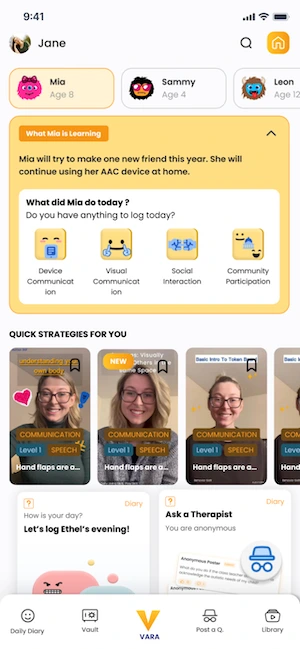
In the VARA app, AI-guided Goals helps you pick one developmental goal to focus on, so practice has a clear direction instead of trying everything at once. AI parent coaching gives you guidance between appointments on applying a strategy in everyday moments, so you feel confident you are doing it right.
 AI-guided Goals
Food Communication Cards: Common Questions
Are these food picture cards printable and free?
Yes. Communication Cards: Food is a free download. Use the “Download This Visual Resource” button, print the food picture cards at home, then cut them out. Laminating them, or covering them with clear tape, helps them survive sticky fingers and spills. Add Velcro dots if you want to stick them onto a choice board or schedule.
Why does an autism food visual help at mealtimes?
Many autistic children process pictures more easily than spoken words, especially when they are hungry, tired or in a busy room. A food visual stays put, so your child can take their time, point and be understood without needing to find the words. It also helps you show what is on offer, which can make new or changing meals feel more predictable. For more on mealtimes, see our tips on picky eating in autistic children.
What if my child doesn’t use the cards yet?
That is common at the start. Keep modeling: point to the card yourself as you say the food’s name and hand it over. Offer only foods your child really wants, keep choices to two, and keep it low pressure. Some children watch for weeks before they use a card themselves.
How can you see which food cards your child uses most?
Small notes add up. After meals, jot down which cards your child used, whether they pointed, touched or handed them over, and anything that made it harder, like a noisy room or a new food on the plate. After a few weeks you may see that your child chooses more at breakfast, or uses cards more at home than at school. That helps you decide which foods to add next and what to share with your child’s speech therapist.
In the VARA app, Daily Diary takes quick daily notes on what you practiced, what happened, and the wins and challenges, and short, messy entries are fine. Insight Reports turn your diary entries into patterns and progress over time that you can share with your child’s clinician, school or a new provider. They document patterns; they do not diagnose.
Daily DiaryFor more ways to use food visuals, see our meal and food choice board. You can also find more free printable communication cards for everyday activities.

Rachael Young is a behavior analyst with Autism 360, specializing in tailored, evidence-based support that improves daily life for children and their families. She is an Adjunct Instructor at Arizona State University, where she trains the next generation of behavior analysts, and is completing a PsyD in Clinical Psychology to deepen her clinical practice. Rachael is proud to identify as neurodivergent, and that lived perspective shapes the empathy and practicality of her work. She writes about ABA, autism in girls and women, co-occurring conditions and the teen years.