


There are three autism levels: level 1 (requiring support), level 2 (requiring substantial support) and level 3 (requiring very substantial support). The levels describe how much support a person needs in daily life, not how intelligent or capable they are.
Autism shows up in many different ways in the early years. Understanding, ongoing support and access to the right help make a real difference as a child grows into a teenager and adult.
But did you know autism is described as a spectrum with three different levels? Each person on the autism spectrum is different and has their own strengths, interests and challenges, so there is no single way of identifying or supporting autism that works for every autistic person.
In this post, we’ll cover autism and the three autism spectrum levels that describe it, with the autism levels explained in plain language. Here’s everything you need to know.
What is Autism?
Autism is a lifelong neurodevelopmental difference that affects how a person communicates, relates to others and experiences the world around them.
Autism usually becomes noticeable in the early years and lasts a lifetime. How much autism symptoms affect daily life varies a lot. Some people need a little support, while others need a great deal of support every day.
Research suggests autism is largely genetic, with some environmental factors before birth also playing a part. Autism isn’t an illness, so it isn’t something to be cured.
Early identification and the right support can help autistic people live happier and more fulfilling lives.
Characteristics of Autism
Autistic traits vary from one person to another. The most common characteristics of autism include:
- Communication differences: these may include differences in spoken and non-spoken communication, vocabulary development, how language is used, eye contact and tone of voice.
- Social interaction differences: these may include finding it harder to start or keep up conversations, read social cues, form friendships or take part in group activities.
- Sensory sensitivities: such as sensitivity to some textures, sounds, lights or smells, which can cause discomfort or distress in certain environments.
- Repetitive patterns of behavior: repeating routines or movements, such as hand-flapping or lining up items. These behaviors often help with calm, focus and joy, though they can sometimes make certain everyday situations harder.
- Finding changes to routine hard: kids with autism often thrive on predictability and routines. Changes, new situations or new environments can feel very stressful.
- Deep, focused interests: many autistic kids are intensely interested in specific topics or hobbies, and may love to talk about them in detail.
- Executive functioning differences: planning, organization and problem-solving can be harder, which can make it tricky to manage tasks, chores or responsibilities without help.
Not all autistic people have all of these traits, and how strongly they show up varies from person to person.
The autism spectrum is a many-sided picture. Traits and support needs vary widely among children and adults, which is why it’s called a spectrum.
The DSM 5 sets out the criteria for diagnosing autism. A diagnosis requires persistent differences in social communication (the DSM-5 calls these “deficits”), along with repetitive patterns of behavior or interests, which often give the person comfort and help them self-regulate.
How Many Levels of Autism are There?
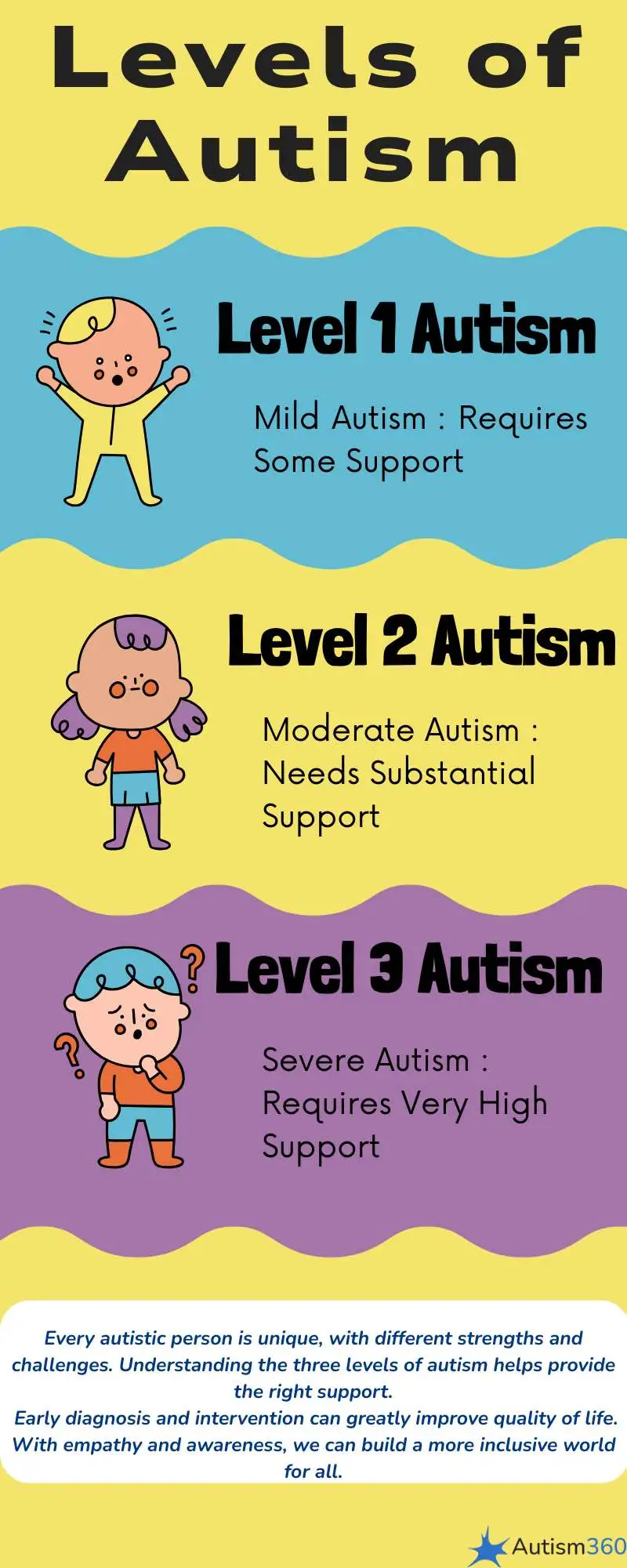
So, what are the levels of autism? There are three levels of autism: Level 1 Autism (requiring support), Level 2 Autism (requiring substantial support) and Level 3 Autism (requiring very substantial support). These levels are based on the amount of support a person needs in daily life.
Every autistic person is unique, and a clinician may give a different level for social communication and for repetitive behaviors. Understanding the autism spectrum scale helps parents, caregivers and health professionals assess needs, provide the right support and plan helpful strategies.
At each level, people have different needs and require different amounts of help. Even within the same level, no two people experience autism in exactly the same way. Learning about these levels gives a clearer picture of how autism affects daily life, and helps us approach support with empathy and understanding.
Autism Levels Chart
| Level | Support needed | What it can look like |
|---|---|---|
| Level 1 | Requiring support | Speaks in full sentences but finds conversation and friendships harder; may find change and organization hard; often masks differences |
| Level 2 | Requiring substantial support | Social communication differences are clear even with support; may speak in short sentences; changes to routine cause noticeable distress |
| Level 3 | Requiring very substantial support | Often non-speaking or uses few words; needs help with most daily activities; changes and sensory overload can be very distressing |
The Three Levels of Autism are:
1. Level 1 Autism
Level 1 autism is the level with the lowest support needs. It is sometimes described as mild autism or high functioning autism, but these labels can hide real needs. It also includes many people who were previously diagnosed with Asperger’s syndrome. The name Asperger’s has been dropped from formal diagnosis, and many in the autism community prefer not to use it because of Hans Asperger’s links to the Nazi regime.
People with level 1 autism usually speak in full sentences and understand what is said, but may find it hard to start and keep up conversations. They may find some social settings tiring or confusing, and may feel awkward or tongue-tied when trying to express themselves in social situations.
Level 1 autistic people need some support in daily life, but are often quite independent.
Here are a Few Characteristics of Level 1 Autism
- Less eye contact, or eye contact that feels uncomfortable
- Becoming overwhelmed or frustrated quickly when things don’t go to plan
- Finding multitasking hard
- Relying on specific routines, like eating from the same plate
- Finding goals and time management hard
- Finding group activities hard to join
Children with Level 1 Autism may also Find it Harder to
- Start conversations with their peers
- Stay engaged in conversations that aren’t about their interests
- Respond in the way their peers expect
People with Level 1 Autism may additionally
- Need outside support with planning and organization
- Find it hard to adapt to different environments
- Feel more comfortable following certain routines
- Find it hard to build and keep friendships without the right support
2. Level 2 Autism
Children with level 2 autism need more support than those with level 1 autism. Their communication and social differences are more noticeable, and repetitive behaviors and focused interests are often more obvious. Many children with level 2 autism find both spoken and non-verbal communication hard.
They may also find social cues hard to understand and respond to them in ways others don’t expect. Children with level 1 autism can have some of the same experiences, but they are more pronounced at level 2.
For children with level 2 autism, changes to routine can cause a lot of stress and anxiety, which may show up as meltdowns, distress or behavior that others find hard to understand. This behavior is communication: it tells us the change was too much.
Here are Some other Typical Characteristics of Level 2 Autism
- Social communication differences, including in spoken and non-verbal communication
- Finding it hard to start and keep up conversations or read social cues
- Repetitive patterns of behavior
- Repetitive movements, or a strong need to stick to schedules and routines
- Deep, focused interests
- Less eye contact
- Pulling away from social situations
- Sensitivity to particular sounds, sights, smells and textures
- Stimming, like hand flapping, rocking or pacing
- Self-injury, such as head-banging or biting, when distressed (always talk to your child’s doctor or therapist about this)
Many children with level 2 autism also have strong food preferences and sensitivity to certain food textures. For example, some children may only eat foods of a certain color or a few specific grains.
The needs of children with level 2 autism are usually more obvious than for those with level 1 autism, and they need more support for everyday life.
Children with level 2 autism need substantial outside support to build coping strategies.
Generally, people at this level need daily support with language, social situations and managing change.
3. Level 3 Autism
Level 3 autism means a child needs very substantial support. Many people at this level are nonverbal (non-speaking) or use only a few words, and may communicate through gestures, sounds, pictures or AAC (alternative and augmentative communication). Not speaking doesn’t mean not understanding, so always presume competence and talk with your child, not about them.
People at this level often rely heavily on routines and find changes to their schedules very distressing.
Many people with level 3 autism have very repetitive or restricted behaviors, which can make it hard to move from one task to another without constant support. They often need help with day-to-day activities. Even everyday tasks like eating, bathing, dressing or going to school can be very hard.
Some Signs You May Notice in People with Autism Level 3
- Frequent, intense stimming such as hand flapping and rocking
- Rarely joining in group activities
- Needing help with most daily tasks
- A co-occurring intellectual disability in some people (this is a separate condition, not part of the autism level)
Many parents and caregivers have a good sense of where their child sits within the three autism levels, but it’s always recommended to get a formal diagnosis from a qualified professional.
Autism really is a spectrum and looks different from person to person. The better we understand these differences, the more we can work together to support our autistic loved ones. It’s important to understand what each level means for each autistic person.
Note that the three levels of autism are not a measure of intelligence. Like their non-autistic peers, kids with autism have a wide range of cognitive abilities. Specialists use the three levels to describe how much support a person needs, based on how much their autistic traits affect daily life.
Note: Many people find inspiration in autism quotes that celebrate strength, resilience and individuality. These quotes highlight the positive side of autism, encouraging families to embrace differences and focus on strengths rather than limitations.
Levels of Autism in Kids: What Parents Should Know
When it comes to levels of autism in kids, a few points can save a lot of worry:
- A level describes support needs right now. It is not a prediction of who your child will become.
- Levels can change. With the right support, communication and confidence often grow. Stress, illness or big transitions (like starting school) can also increase a child’s support needs for a while.
- Your child may have different levels for different areas. A child can need more support with social communication than with routines, or the other way around.
- Funding systems use levels differently. In Australia, the NDIS looks at your child’s functional needs, not just the level written in their report, so ask your clinician to describe everyday impacts clearly.
Are There Stages of Autism?
No. Autism doesn’t have stages, and autism stages aren’t part of any diagnosis. Autism is not a progressive condition that moves from one stage to the next. When people search for the “stages of autism”, they usually mean the three levels, or the way autistic traits can look different in toddlers, school-age children, teenagers and adults. The different levels of autism describe support needs, not a timeline.
Are There 5 Levels of Autism?
No. The DSM-5 describes three levels of autism, not five. The idea of “5 levels” usually comes from the older system, which had five separate diagnoses (autistic disorder, Asperger’s syndrome, PDD-NOS, childhood disintegrative disorder and Rett syndrome). Since 2013, autism has been one diagnosis with three support levels, and Rett syndrome is now diagnosed separately.
Where Am I on the Autism Spectrum?
Several terms have been used over the years when diagnosing autism. These include:
- High Functioning Autism
- PDD NOS (Pervasive Developmental Disorder – Not Otherwise Specified)
- Low Functioning Autism or Severe Autism
- Childhood Disintegrative Disorder (CDD)
Today, terms like “high functioning” and “low functioning” have been replaced by the three autistic levels, which focus on support needs rather than ability.
How Do You Tell What Level of Autism You or Your Child Has?
Talk to your child’s GP, pediatrician or another health professional to find out where you or your child sit on the autism spectrum. They have the tools needed to make an accurate diagnosis and can refer you to specialists.
The diagnostic process for autism involves a series of formal assessments. Your doctor can (and should) work with you to understand what your child finds hard and why. Before the appointment, write down what you notice about your child’s behavior, communication and play, and share it with the doctor.
Keeping the lines of communication open with your doctor is a big step. Your child’s doctor can then assess your child and talk with you about what to expect.
An Evaluation of the Autism Spectrum Scale
As we’ve already mentioned, these levels of autism are not exhaustive or definitive. Each person on the spectrum is unique. The levels help many autistic people get the support they need, but they have some limitations.
The three levels of autism do not fully capture the lived experiences of all people with autism. They say little about what kind of support an autistic person needs, or when they need it.
For instance, some autistic children need school adjustments but do well at home. Others do fine at school but find social situations hard.
A person diagnosed with level 1 autism may build social communication skills over time, yet still find anxiety, depression or the effects of trauma get worse, often because of the effort of masking.
People with level 1 autism may mask (hide) their differences, which can delay diagnosis. For people with level 2 and level 3 autism, social communication can be very hard, and they may need less support in some areas but a lot of support in others. Parents and health professionals work together, using observations and interviews, to make a diagnosis. To give an accurate level, the clinician needs to understand a person’s full range of abilities, strengths and challenges.
Assigning a level can help identify which support services would help. The levels don’t describe a person’s personality or behavior in detail, but they can help with planning support.
Autism is a lifelong difference that affects both children and adults. The right diagnosis, timely support and good care can make a real difference in the life of an autistic person and their loved ones.
Previous Autism Terminology
Every autistic person is unique. The actual characteristics and experiences of autistic people are not as neat as the three levels suggest. Many autistic people have characteristics that match two or more levels, so the levels may not be very helpful beyond diagnosis and funding. Fitting someone into a single level can lead to misunderstandings about what they can do and what they need.
Many myths and misconceptions about autism come from terms that are no longer used. In the previous classification system, autistic people were diagnosed under categories such as:
1. Asperger’s Syndrome
Asperger’s Syndrome described people with lower support needs whose differences mainly affected social communication.
2. PDD-NOS
Autistic children whose traits did not fit either Asperger’s or autistic disorder were often diagnosed with Pervasive Developmental Disorder-Not Otherwise Specified.
3. Autistic Disorder
Children with higher support needs were previously diagnosed with autistic disorder, which described significant social and communication differences, repetitive and focused behaviors and interests, and a need for substantial support in daily life.
The DSM-5 has since combined these categories into a single diagnosis with three levels.
The three autism levels help clinicians recommend the right therapies, based on each person’s abilities, needs and goals. Good support helps autistic people build on their strengths as they develop communication and social skills.
Is Autism Genetic?
Genetics play an important role in autism, and twin studies show that autism is highly heritable. However, a specific genetic cause can only be identified in about 10% to 20% of autistic people. Known genetic causes include changes in genes such as SHANK3 and CHD8, and genetic syndromes such as fragile X syndrome.
Autism Diagnosis

Because autism is a spectrum, diagnosis can be complex. Autism symptoms vary from person to person. Some people show traits of high functioning autism, while others need substantial support in daily life. Sometimes autism isn’t recognized until adulthood, so early identification matters, as it helps people get the right support sooner. Signs of autism are often noticed within the first 2 years.
There is no medical test (like a blood test) for autism. Instead, health professionals use screening tools, observation and detailed assessments.
The Steps Involved in the Autism Diagnosis Process Include:
1. Developmental History
Your child’s doctor will review your child’s development and history, and ask you to share your own observations. This involves talking with you about your child’s abilities, strengths and challenges, and may include input from other specialists, to work out the right next steps.
2. Developmental Screening
Screening looks closely at your child’s developmental milestones, using questionnaires and checklists to compare their development with that of children the same age. Screening doesn’t give a diagnosis, but it can show whether your child should have a fuller assessment.
3. Formal Evaluation
This step takes an in-depth look at your child’s development. A specialist, such as a pediatrician, child psychologist or speech pathologist, will observe and interact with your child in a structured assessment. They will also ask you to fill out forms and answer questions. The results should describe your child’s abilities, strengths and support needs, and the clinician can then decide whether to make a formal diagnosis.
Parents, teachers and caregivers often notice signs of autism in older children. These observations can help inform an assessment.
Diagnosing autism in adults can be harder, because autistic traits can overlap with those of other mental health conditions, and many adults have spent years masking. Adults can ask their GP for a referral to a psychologist or psychiatrist experienced in adult assessment.
Autism Treatment Options
Autism is a lifelong difference, and therapy aims to support a person’s wellbeing, communication and independence rather than to make them less autistic.
Here are Some Commonly Used Supports:
- Applied Behavior Analysis (ABA): ABA is used in some clinics and schools to teach new skills. Many autistic adults have raised concerns about approaches that focus on compliance, so if you consider ABA, look for a provider that is child-led, respects your child’s autonomy and never aims to stop harmless stimming.
- Occupational Therapy: helps with everyday life skills such as eating, bathing, dressing and play, as well as sensory needs, so people can live more independent lives.
- Sensory Integration Therapy: supports autistic people whose sensory sensitivities (to sights, sounds, smells or textures) can lead to sensory overload.
- Speech Therapy: supports all forms of communication, including speech, signing and AAC.
- Autism Medications: There’s no medication that treats autism itself. However, doctors may prescribe medication for co-occurring conditions, such as ADHD, anxiety, sleep difficulties or severe irritability, when these are affecting a person’s quality of life.
Autism Prevention
So, are there measures a parent can take to prevent autism in their children?
No, autism cannot be prevented. It is a natural variation in how the brain develops, and it is largely genetic. What parents can do is support a healthy pregnancy, which is good for every baby’s development:
- Lead a healthy lifestyle, eat a balanced diet, exercise and see your doctor regularly.
- Get regular prenatal care and take recommended vitamins, such as folic acid.
- Check which medicines are safe during pregnancy, and avoid unsafe ones.
- Avoid smoking and alcohol.
- Get recommended vaccines, such as rubella, before getting pregnant.
None of these steps guarantee anything about whether a child will be autistic, and if your child is autistic, it isn’t because of something you did.
What is the Outlook of People with Autism?
Autistic people can live full, meaningful lives, and many need some ongoing support. Their support needs depend on their traits and circumstances.
Life can be hard for autistic people and their families, especially in a world that isn’t designed for them. Early identification and support can make a real difference to wellbeing, and the right environment, therapy and (where needed) medication for co-occurring conditions can make daily life much easier.
With the right support, many people with level 1 autism live independent lives. People with level 2 autism often need substantial support with social situations and change. People with level 3 autism may rely on others for daily tasks, and therapy and the right supports can help them communicate, feel safe and take part in the things they enjoy.
During autism awareness month, people around the world wear autism colors (often blue, red and gold) and display the autism ribbon to show solidarity. These gestures symbolize hope, inclusion and understanding for autistic people and their families.
Conclusion: Understanding Your Child’s Autism Level
Every autistic person is different and has their own strengths and challenges. It is completely understandable for families to have questions about the support and services available for their children.
Talk with your health professionals about your child’s autism level and support options. They can help make sure your child gets the support that suits their needs best.

Special Educator of over 15 years. Autism specialist, Sign Language interpreter, and Autism Mommy. Currently working on my Master’s in ABA and love learning more about sensory needs, and assisting families on their journey through Autism. In my free time you will find me outside, and traveling the world. My bucket list and travels will always consist of hiking and National Parks!


