

Autism and schizophrenia are different conditions, but research shows they share some genetic and biological links, and autistic people are more likely than others to be diagnosed with schizophrenia. Even so, most autistic people never develop it.
Key takeaways: autism and schizophrenia
- Autism and schizophrenia are different conditions with some shared genetic links, and most autistic people never develop schizophrenia.
- Signs of schizophrenia in autism are about change, such as hearing or seeing things others cannot, new strong unusual beliefs, or confused speech.
- Seek help promptly from your GP or pediatrician if you notice new withdrawal, confused thinking or hallucinations, ideally with a clinician who knows autism.
- Childhood schizophrenia autism confusion is historical, as autism was once called childhood schizophrenia until around the 1970s and 1980s.
- Yes, you can have both, which is uncommon, and it needs careful assessment by clinicians who know both conditions.
Schizophrenia and autism spectrum disorder (ASD) have long interested researchers. Recent studies have found some surprising connections between two conditions that look very different. Understanding these connections can improve our understanding of both, and help us better support autistic people, people with schizophrenia and their families.
Groundbreaking Study on Genetic Risk and Brain Activity
Some of the most detailed insights into the biology of autism have come from a major study led by UCLA Health. Think of the brain as a city, where each cell is a house and genes are the blueprints for those houses.
Researchers used a special technique to look at over 800,000 of these “blueprints” from the brains of people with autism and people without autism. They found specific patterns in the brains of autistic people that differ from those of neurotypical people.
These findings help us understand how genetic factors linked to autism translate into differences in brain activity, which can help in developing better support and treatments for co-occurring conditions.
Gene Expression Patterns in Healthy Brains and Mental Health Conditions
Building on the UCLA study, researchers at the University of Cambridge explored how genes work in the brains of people without these conditions and in people with ASD or schizophrenia.
Think of gene expression as lights turning on and off in different parts of the brain. They found three distinct lighting patterns: two linked to autism and one to schizophrenia. It’s like discovering different neighborhoods in the brain city where the lights behave differently, giving us clues about the biology of each condition.
Understanding these patterns could help reveal the biological causes of these conditions and lead to more effective support.
Scientists have suggested that schizophrenia and autism might share some genetic roots, just as different plants can grow from the same seed under different conditions.
Research published in 2021 found that children of parents with schizophrenia more often show traits associated with autism. This suggests there may be a connection between the genetic origins of the two conditions.
Is There an Increased Risk of Schizophrenia in Individuals with ASD?
Is there an increased risk of schizophrenia for autistic people? Research suggests that people with ASD are more likely to be diagnosed with schizophrenia than people without autism, although most autistic people never develop schizophrenia.
Why is this? Evidence suggests that shared genetic factors, differences in brain development and overlapping environmental influences may all contribute. It’s important to keep an eye on the mental health of autistic people, so that any new mental health condition, including a possible dual diagnosis, is picked up early.
Recognizing Early Signs of Schizophrenia in Children with Autism
It’s important for pediatricians and parents to be able to recognize the early signs of schizophrenia in children with autism. These signs don’t always mean a child has schizophrenia, but they can suggest that another mental health condition may be present or developing.
Delusions and hallucinations are more specific to schizophrenia, and are called “positive symptoms” (experiences that are added). Autism and schizophrenia can share some “negative symptoms” (things that are reduced), such as less social interaction or less spoken communication, although in autism these are lifelong differences rather than a change. When telling the two apart, clinicians pay close attention to whether positive symptoms are present.
Signs of Schizophrenia in Autism
Signs of schizophrenia in autism are usually about change. Look for a clear shift from your child’s own usual way of being, rather than autistic traits they’ve always had. Signs can include:
- Hearing, seeing or feeling things that others can’t
- Strong, unusual beliefs that don’t fit reality and can’t be talked through, for example believing they’re being watched or controlled
- Speech or thinking that becomes confused or hard to follow, beyond how your child usually communicates
- A marked drop in self-care, school work or interest in their passions
- Increased withdrawal, suspicion or fearfulness that is new for them
Because many autistic people take language literally, have vivid inner worlds or talk about their passions in great detail, these can sometimes be mistaken for psychosis. A clinician who knows autism well is the best person to tell the difference. We look at this in more detail in our guide to autism and hallucinations.
Understanding the Distinctions Between Autism-Related Behaviors and Schizophrenia Symptoms
A study published in Frontiers in Psychiatry looked at what distinguishes autistic adults from adults with schizophrenia. It found that positive symptoms, such as delusions and hallucinations, were the most helpful in telling the two conditions apart.
There are, however, similarities in negative symptoms, such as social withdrawal and less spoken communication, which can be seen in both groups. The E/I imbalance hypothesis is another important idea. It suggests that changes in the balance of excitatory and inhibitory activity in the brain’s cortex may play a part in both conditions.
A better understanding of these shared brain mechanisms could make support more effective.
Exploring Treatment Options for Children with Autism and Schizophrenia
Supporting people who are both autistic and have schizophrenia can be complex. A national multicenter study looked at the different support offered to autistic people with intellectual disability who also have schizophrenia. The research suggests that higher IQ may be linked to better outcomes for autistic people with schizophrenia.
Even so, people with autism with schizophrenia often face significant challenges, and need well-coordinated mental health and disability support.
Exploring the Long-Term Outcomes of Autism and Schizophrenia
Longitudinal studies, which follow people over many years, have reported that many people with autism have poorer outcomes in adulthood, as measured by things like independent living, employment and friendships. In one analysis, approximately 20% had a good outcome, 26.6% a moderate outcome and 49.3% a poorer outcome. These measures don’t capture everything that matters to autistic people, such as wellbeing and acceptance, and better support and understanding can change these numbers.
The Research Domain Criteria (RDoC) framework aims to group conditions by shared biological mechanisms. This approach could lead to more precise support and better long-term results.
Potential Impact on Parents
These findings can feel overwhelming for parents of autistic children, but they also offer a roadmap for better support and care. Knowing about the higher risk of schizophrenia can help parents be alert and proactive about their child’s mental wellbeing. Here are some signs to be aware of:
- Changes in Behavior: sudden changes in mood or behavior, such as becoming more withdrawn or having big mood swings.
- Cognitive Changes: difficulty thinking clearly, concentrating or remembering information, compared with before.
- Hallucinations or delusions: sensing things that aren’t there, or holding beliefs that aren’t based in reality.
- Social Withdrawal: avoiding social contact and becoming more isolated than usual.
Recognizing and acting on changes early can make a real difference. If you notice any of these signs, seek professional help promptly, starting with your GP or your child’s pediatrician. Early support and therapy can help a great deal in managing symptoms and improving quality of life.
Difference Between Autism and Schizophrenia
To understand the link between autism and schizophrenia, it helps to know what makes each condition distinct. By looking at the core features, onset and development of autism spectrum disorder (ASD) and schizophrenia, we can see how the two diagnoses may overlap. This section also looks at what a comorbid diagnosis (having both conditions) might look like, and the challenges that can come with it.
Signs and Symptoms of Autism Spectrum Disorder (ASD)
Core Features
- Social Communication Differences: children with ASD often communicate and connect differently, for example with eye contact, nonverbal cues and back-and-forth conversation.
- Restricted and Repetitive Behaviors: these include repeated movements, a strong preference for routines, deep interests in specific topics, and being more or less sensitive to sensory input (for example touch and sound).
Onset and Development
- Early Childhood: Autism symptoms often appear in early childhood, frequently before the age of 2.
- Stability Over Time: autistic traits are lifelong, and the right support can make daily life easier and help a person thrive.
Individual Variation
Not all autistic people (people with ASD) show the same characteristics, and support needs vary greatly from person to person. It’s important to recognize and respect these differences and provide support tailored to each person’s needs. Early support and ongoing understanding can make a big difference to an autistic person’s quality of life and ability to thrive in different environments.
Schizophrenia Symptoms
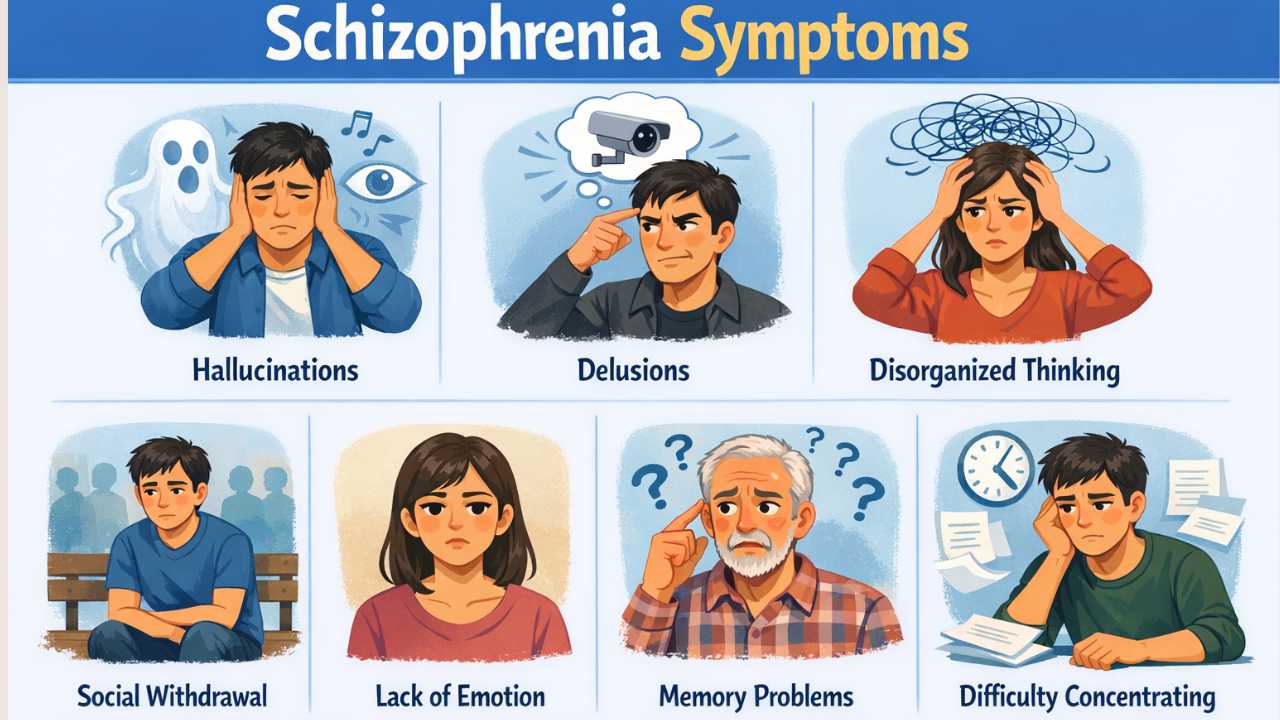
Schizophrenia symptoms include hallucinations, delusions, disorganized thinking, social withdrawal, reduced emotional expression and difficulty concentrating. They are usually grouped into positive, negative and cognitive symptoms, and need professional diagnosis and treatment. Hallucinations and delusions are signs of psychosis, and our guide to the types of psychosis explains how these experiences are grouped.
Core Features
- Positive symptoms: (an excess or distortion of usual experience) include hallucinations, delusions and confused speech.
- Negative symptoms: (a decrease in usual motivation and interest) include social withdrawal, reduced speech and low emotional expression.
- Cognitive symptoms: these affect thinking, memory and attention, and can make daily activities much harder.
Onset and Development
- Age of Onset: Schizophrenia symptoms usually start in the late teenage years or early adulthood.
- Treatment: negative symptoms can be hard to treat, and may continue even with treatment.
Differentiation from ASD
- Age of Onset: signs of autism appear much earlier than those of schizophrenia.
- Differences in Symptoms: both can involve social differences, but there are clear differences between schizophrenia and autism spectrum disorder (ASD). For example, schizophrenia involves hallucinations and delusions, which are not part of ASD.
- Differences in Treatment: treatment for schizophrenia usually focuses on reducing positive symptoms, often with medication. Support for autistic people focuses on communication, daily living skills, sensory needs and wellbeing, not on removing autistic traits.
Overlap and Misdiagnosis
- Historically, autism was classified as part of the schizophrenia spectrum.
- Sometimes autistic people who have no signs of psychosis are wrongly diagnosed with schizophrenia, because some behaviors can look similar.
- Assessment tools need to be used carefully, because some questions can be misinterpreted. For example, an autistic person’s deep interests might be mistaken for delusions. Assessments should always be done with care and with autism in mind.
Childhood Schizophrenia and Autism
In the past, autism was sometimes called “childhood schizophrenia”, and the two weren’t clearly separated until around the 1970s and 1980s. Today we know they are different conditions. Childhood-onset schizophrenia (starting before age 13) is very rare, while autism is much more common. When childhood schizophrenia and autism do occur together, early autistic traits often come first, with psychotic symptoms appearing later. This history is why the phrase childhood schizophrenia autism still appears in older records and research.
Can You Have Autism and Schizophrenia?
Yes. You can have autism and schizophrenia at the same time, which doctors may call comorbid autism and schizophrenia (two co-occurring conditions). Autism with schizophrenia is uncommon, but it does happen, and it needs careful assessment by clinicians who understand both conditions. Schizophrenia autism overlap can make diagnosis tricky, so it helps to bring a clear history of the person’s lifelong autistic traits, and of any new changes, to appointments. If autism hasn’t been assessed yet, our free online autism test can help you note early traits before that appointment.
Is Schizophrenia Genetic?

Yes, schizophrenia has a genetic component, which means it can run in families. However, genetics alone don’t cause schizophrenia. Environmental and brain development factors also play an important role.
Implications of the Research
These findings are important for understanding both autism and schizophrenia. Understanding the shared autism schizophrenia genetic and biological factors may help researchers develop more precise treatments for schizophrenia, and better support for autistic people who experience mental health conditions. A whole-person approach can lead to better results for individuals and their families.
📌 MUST READ:
Autism Co-Existing Conditions
Is OCD on the Autism Spectrum?
How are Tourettes and Autism Connected?
Autism and Epilepsy: Is There a Connection?
How are Oppositional Defiant Disorder (ODD) and Autism Connected?
Conclusion
Although autism and schizophrenia are distinct conditions, recent studies show they share some genetic and biological similarities. Understanding these connections helps in developing more effective support and treatment. Health professionals can then tailor support to each person’s needs and improve their quality of life.
By understanding the possible links between autism and schizophrenia, parents can keep a closer eye on their child’s mental health and get help early if something changes.
As research progresses, we can hope for better lives for people affected by these conditions, and more clarity for their families. Every new discovery brings us closer to a future where both conditions are better understood and effective, compassionate care is available to everyone.

Rachael Young is a behavior analyst with Autism 360, specializing in tailored, evidence-based support that improves daily life for children and their families. She is an Adjunct Instructor at Arizona State University, where she trains the next generation of behavior analysts, and is completing a PsyD in Clinical Psychology to deepen her clinical practice. Rachael is proud to identify as neurodivergent, and that lived perspective shapes the empathy and practicality of her work. She writes about ABA, autism in girls and women, co-occurring conditions and the teen years.